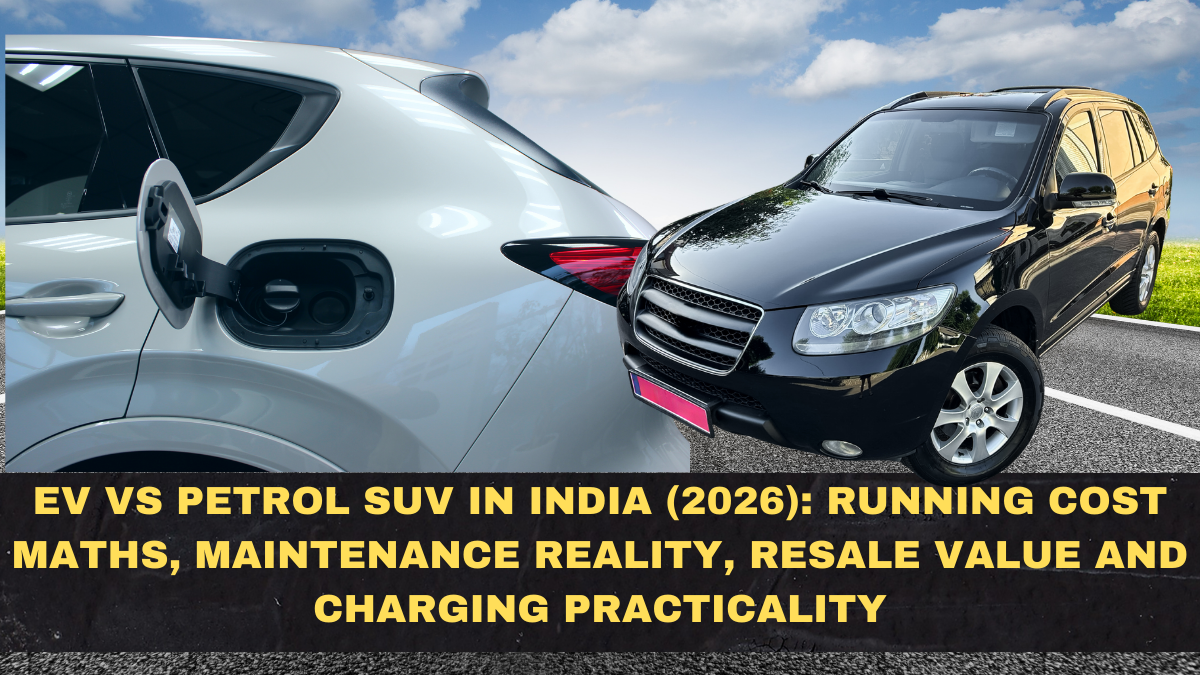
The EV vs petrol SUV debate in India in 2026 is no longer a future-facing conversation. It is a present-day financial and psychological decision that thousands of families are actively making every month. What has changed is not just the availability of electric SUVs. What has changed is buyer behavior.
Indian car buyers are no longer asking, “Is EV the future?” They are asking, “Which one costs me less stress, less money, and fewer regrets over five years?”
That is a much harder and much more honest question.
So instead of hype, brand promises, or environmental virtue signaling, this guide breaks down the EV vs petrol SUV cost in India 2026 using the four things that actually matter in real ownership: running cost maths, maintenance reality, resale value psychology, and charging practicality.
Why This Comparison Matters More Than Ever in 2026
In 2026, both EV SUVs and petrol SUVs are finally “good enough” products.
Petrol SUVs are:
-
More refined
-
More fuel-efficient than before
-
Packed with tech
-
Safer and more comfortable
EV SUVs are:
-
Longer-range
-
Faster-charging
-
Better supported by service networks
-
More mainstream than ever
This means the choice is no longer obvious.
It is now a personal economics and lifestyle fit decision.
Upfront Price: The First Psychological Barrier
The first thing buyers emotionally react to is sticker price.
In most comparable segments:
-
EV SUVs cost ₹4–8 lakh more upfront than petrol SUVs.
-
Even after government incentives, EVs remain meaningfully more expensive to buy.
This price gap creates immediate resistance, especially among middle-class buyers.
But this is also where most people stop thinking.
Which is a mistake.
Running Cost Maths: Where EVs Quietly Win
This is where the economics flip.
In real-world Indian conditions in 2026:
-
A petrol SUV costs roughly ₹7–10 per km to run.
-
An EV SUV costs roughly ₹1–2 per km to run using home charging.
That means:
-
At 1,000 km per month →
Petrol SUV: ₹7,000–₹10,000
EV SUV: ₹1,000–₹2,000
Over five years of ownership:
-
Petrol SUV fuel cost: ₹4–6 lakh
-
EV SUV electricity cost: ₹60,000–₹1.2 lakh
That is a massive structural difference.
This is the single biggest reason EV ownership starts making financial sense after two to three years.
Maintenance Reality: The Silent EV Advantage
Maintenance is where EVs become emotionally liberating.
Petrol SUVs require:
-
Engine oil changes
-
Gearbox servicing
-
Clutch replacements
-
Exhaust system maintenance
-
Regular filter replacements
-
More frequent brake servicing
EV SUVs eliminate most of this.
In real-world 2026 ownership:
-
EV maintenance costs are 40–60% lower than petrol SUVs.
-
Annual servicing bills are dramatically smaller.
-
Fewer mechanical failures occur.
This is not a theoretical benefit.
It shows up in real service invoices.
Over five years, EV owners typically save another ₹1–2 lakh in maintenance alone.
Battery Replacement Fear: The Biggest Psychological Myth
This is where most buyers panic irrationally.
Modern EV batteries in 2026:
-
Are designed to last 8–12 years.
-
Come with 8-year warranties in most cases.
-
Degrade slowly, not suddenly.
Real-world data now shows:
-
Battery degradation of only 10–15% after five years.
This fear is emotionally powerful but statistically weak.
Most owners will sell their EV long before battery replacement becomes relevant.
Resale Value: The Most Uncertain Variable
This is the one area where petrol SUVs still feel emotionally safer.
Petrol SUV resale behavior:
-
Extremely predictable
-
Strong brand trust
-
Stable used-car demand
EV SUV resale behavior in 2026:
-
Improving rapidly
-
Still slightly uncertain
-
Highly dependent on brand trust and battery warranty
However, something important has changed.
Used EV demand has started rising sharply in cities.
Why?
Because:
-
New EVs remain expensive
-
Buyers trust battery warranties
-
Running costs matter more than prestige
This means EV resale anxiety is fading, not increasing.
Charging Practicality: The Real Lifestyle Divider
This is the most important non-financial factor.
If you have home charging access:
-
EV ownership is effortless.
-
Daily charging becomes invisible.
-
Range anxiety disappears.
If you do not have home charging:
-
EV ownership becomes stressful.
-
Public charging dependency is annoying.
-
Waiting times and broken chargers become emotional friction.
This single factor determines whether EV ownership feels liberating or miserable.
It matters more than price, range, or brand.
Highway Use vs City Use: The Reality Check
Usage pattern changes everything.
If your driving is:
-
Mostly city → EV makes overwhelming sense.
-
Mostly highway → Petrol still feels easier and safer.
-
Mixed → EV works if charging is convenient.
EVs shine in stop-and-go city traffic.
Petrol SUVs still dominate in:
-
Remote travel
-
Unpredictable long-distance trips
-
Areas with weak charging networks
This is not ideology.
This is logistics.
Five-Year Total Cost of Ownership Comparison
Here is the blunt financial truth for a mid-size SUV buyer in 2026.
Over five years:
Petrol SUV:
-
Higher purchase price advantage
-
Higher fuel cost
-
Higher maintenance cost
-
Stable resale value
EV SUV:
-
Higher purchase price
-
Extremely low running cost
-
Low maintenance cost
-
Slight resale uncertainty
In most urban usage scenarios:
-
EV SUVs end up ₹2–4 lakh cheaper to own over five years.
This is not marketing.
This is arithmetic.
Who Should Choose an EV SUV in 2026
EV SUVs make sense for:
-
City-focused drivers
-
Daily office commuters
-
Families with home parking
-
Buyers keeping cars for 5+ years
-
Buyers sensitive to fuel costs
For these users, EV ownership becomes emotionally addictive.
Once you experience silent driving and zero fuel bills, going back to petrol feels painful.
Who Should Still Choose a Petrol SUV
Petrol SUVs still make sense for:
-
Highway-heavy users
-
Rural or semi-urban buyers
-
Buyers without home charging
-
Short-term owners
-
Buyers with resale anxiety
For these users, petrol still offers psychological peace of mind.
The Real Answer Nobody Wants to Hear
There is no universal winner in the EV vs petrol SUV debate in India 2026.
The winner is decided by:
-
Your parking situation
-
Your daily driving pattern
-
Your ownership duration
-
Your psychological tolerance for change
This is not a technology decision.
It is a lifestyle decision.
Conclusion: EV vs Petrol SUV in India 2026
If you strip away emotion, fear, and hype, one truth remains.
For urban Indian families with home charging, EV SUVs are already the financially superior choice in 2026.
They cost less to run.
They cost less to maintain.
They feel better to drive daily.
Petrol SUVs still win on flexibility, resale certainty, and highway convenience.
So the real question is not “Which is better?”
It is “Which one fits the way you actually live?”
Answer that honestly, and the decision becomes obvious.
FAQs
Are EV SUVs cheaper to own than petrol SUVs in 2026?
Yes. In most urban usage scenarios, EV SUVs are ₹2–4 lakh cheaper to own over five years.
Is EV maintenance really lower than petrol?
Yes. EVs have far fewer moving parts and significantly lower servicing costs.
Will EV batteries need replacement in five years?
No. Modern EV batteries degrade slowly and are covered by long warranties.
Is resale value of EVs a risk in 2026?
It is improving rapidly and is no longer a major risk for trust brands.
Do I need home charging for an EV SUV?
Yes. Home charging is the single biggest factor that makes EV ownership practical.
Who should still buy a petrol SUV in 2026?
Highway-heavy users, rural buyers, and those without home charging access.