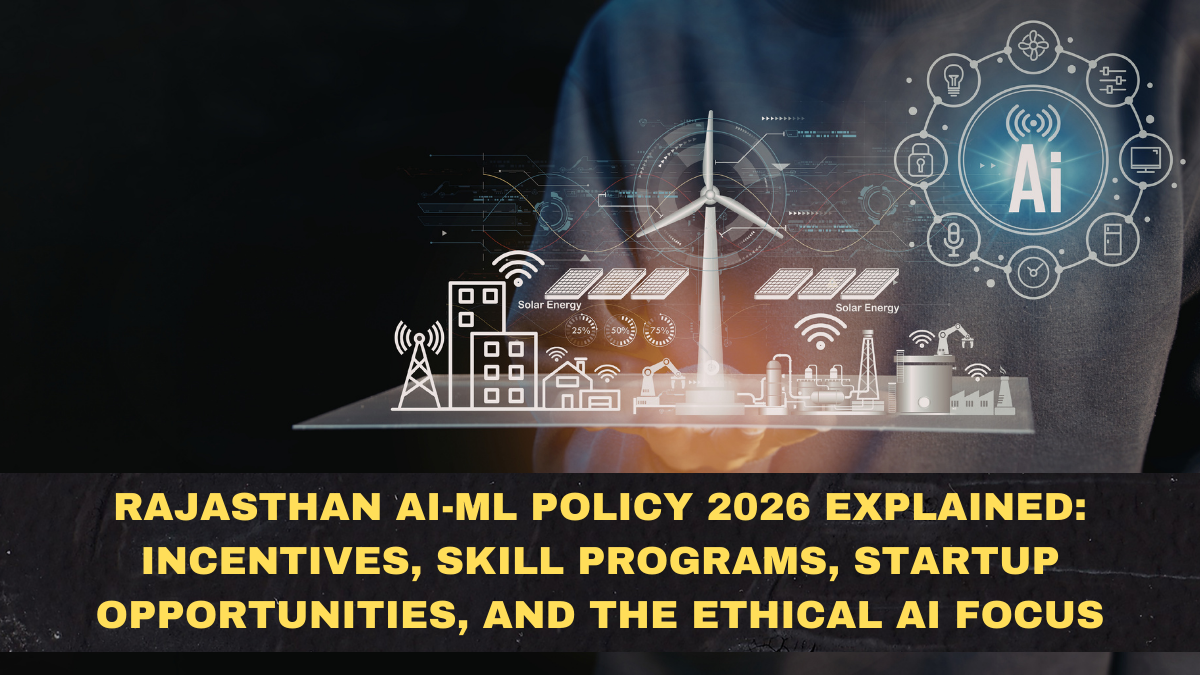
Rajasthan has quietly entered a race that most people still think only Karnataka, Telangana, and Maharashtra are running. With the Rajasthan AI-ML Policy 2026, the state government is making a serious attempt to position itself as a credible regional hub for artificial intelligence, machine learning, and data-driven innovation. This is not a cosmetic policy meant for press releases. It is a structural push aimed at jobs, startups, skills, and public-sector transformation.
For years, Rajasthan has been seen as a lagging tech state, known more for tourism, mining, and traditional industries than for deep technology. That perception is exactly what this policy is trying to break. The state is now betting that AI-led growth can leapfrog its economic profile and attract both domestic and global tech investment.
This article explains what the Rajasthan AI-ML Policy 2026 actually contains, what incentives and programs it introduces, how it affects startups and students, and why its ethical AI positioning matters far more than most people realize.
Why Rajasthan Is Pushing an AI-ML Policy Now
The timing of this policy is not accidental. By 2026, AI adoption is no longer experimental in India. It is becoming embedded in governance, finance, healthcare, logistics, education, and manufacturing. States that fail to build AI ecosystems now risk becoming digitally irrelevant within a decade.
Rajasthan also faces a structural employment challenge. A young population, limited private-sector job creation, and slow industrial diversification have created pressure to find new growth engines. AI and digital services offer a path that does not require massive physical infrastructure in the way traditional manufacturing does.
From the government’s perspective, the policy is not about technology glamour. It is about long-term economic survival and relevance.
What the Rajasthan AI-ML Policy 2026 Is Trying to Achieve
At a high level, the policy has four strategic goals. First, attract AI startups and companies to operate from Rajasthan instead of migrating to Bengaluru or Hyderabad. Second, build a local talent pipeline so students do not have to leave the state for serious tech careers. Third, use AI to modernize state governance and public services. Fourth, position Rajasthan as a responsible AI state with ethical and transparency standards.
This is not a single-project policy. It is an ecosystem policy. Its success depends on whether incentives, skills, and infrastructure move in sync instead of operating in silos.
That alignment is what will decide whether this becomes a real transformation or just another underused government scheme.
Startup Incentives and Financial Support Explained
One of the strongest elements of the policy is its startup incentive framework. Rajasthan is offering financial grants, seed funding support, and operational subsidies to AI and ML startups that register or relocate to the state.
These incentives are designed to reduce early-stage risk, especially for founders who do not have venture funding. Office rental subsidies, cloud compute credits, and R&D support are part of the broader package.
The strategic logic is simple. If Rajasthan can become a low-cost base for AI startups compared to metro cities, it can attract founders who are currently priced out of Bengaluru and Delhi.
Infrastructure and AI Innovation Zones
The policy also proposes the creation of dedicated AI innovation zones and digital infrastructure clusters. These are meant to provide co-working spaces, incubation centers, research labs, and testing environments for AI solutions.
This matters because startups do not just need money. They need physical ecosystems where talent, mentors, investors, and early customers exist in one place.
If these zones are executed properly, they can become the physical backbone of Rajasthan’s AI economy.
If they remain symbolic real-estate projects, the policy will fail regardless of incentives.
Skill Development and Education Programs
This is where the policy becomes genuinely high-impact.
Rajasthan is planning large-scale AI and ML skill development programs across universities, engineering colleges, and vocational institutions. These programs are meant to train students, teachers, and government staff in data science, machine learning, and applied AI tools.
The long-term objective is not to produce elite researchers. It is to produce a broad base of job-ready AI practitioners who can work in startups, IT services, government departments, and enterprise roles.
If implemented seriously, this could dramatically reduce brain drain from the state.
Public Sector AI Use Cases
Another major pillar of the policy is AI adoption in government services.
The state plans to use AI for:
-
Predictive healthcare and disease tracking
-
Smart agriculture advisory
-
Traffic and urban planning
-
Land records and governance automation
-
Education analytics
This matters for two reasons. First, it modernizes governance. Second, it creates real-world datasets and use cases that startups can build products around.
Public-sector demand is often the missing link in regional tech ecosystems.
Ethical AI and Transparency Focus
This is the most underrated part of the policy.
Rajasthan is explicitly framing its AI push around ethical use, transparency, data protection, and fairness.
That means requiring explainability in high-impact AI systems, human oversight for automated decisions, and safeguards against bias and misuse.
In 2026, this positioning is not philosophical. It is commercially strategic.
Enterprises and governments increasingly prefer vendors who can demonstrate responsible AI practices.
This focus could become Rajasthan’s unique differentiation against other tech states.
What This Policy Means for Startups
For founders, this policy creates three concrete opportunities.
Lower operating costs compared to metro cities.
Access to government datasets and pilot projects.
Early entry into a growing regional ecosystem.
The risk, of course, is execution quality. Incentives on paper mean nothing if approvals are slow, rules are unclear, and bureaucratic friction remains high.
Smart founders will watch implementation signals before relocating.
What This Means for Students and Job Seekers
For students, this policy is a potential career game-changer.
It increases the probability that serious tech jobs will exist inside Rajasthan instead of only outside it.
It also improves the relevance of local education programs by aligning them with industry needs.
Over time, this could reshape the career expectations of an entire generation of Rajasthani students.
How Rajasthan Compares With Other States
Compared to Karnataka or Telangana, Rajasthan is late to the AI game.
But that is not automatically a disadvantage.
Late movers can design better policies by learning from early mistakes made by other states.
If Rajasthan focuses on low-cost advantage, ethical positioning, and strong execution, it can still carve out a meaningful niche.
The Real Risk: Policy Without Execution
This is the hard truth.
India is full of ambitious tech policies that died in implementation.
If incentive disbursement is slow, skill programs are low quality, and innovation zones remain empty buildings, this policy will become symbolic noise.
Execution speed and seriousness will decide everything.
Conclusion: Why Rajasthan’s AI-ML Policy 2026 Is Bigger Than It Looks
The Rajasthan AI-ML Policy 2026 is not just about technology.
It is about economic repositioning.
It is about youth employment.
It is about regional competitiveness.
If implemented well, it can change how Rajasthan is perceived in India’s tech map within a few years.
If implemented poorly, it will join a long list of forgotten government announcements.
The opportunity is real. So is the execution risk.
FAQs
What is the Rajasthan AI-ML Policy 2026?
It is a state government policy to promote AI and ML startups, skills, infrastructure, and ethical AI use in Rajasthan.
What incentives does the policy offer to startups?
It includes grants, seed funding support, rental subsidies, and R&D assistance.
How does the policy help students?
It introduces AI skill programs and aligns education with industry needs.
What is unique about Rajasthan’s AI policy?
Its explicit focus on ethical AI and transparency.
Will startups really move to Rajasthan because of this policy?
Only if incentives and infrastructure are implemented seriously.
Is this policy only for big companies?
No. It is designed mainly to support startups and early-stage founders.