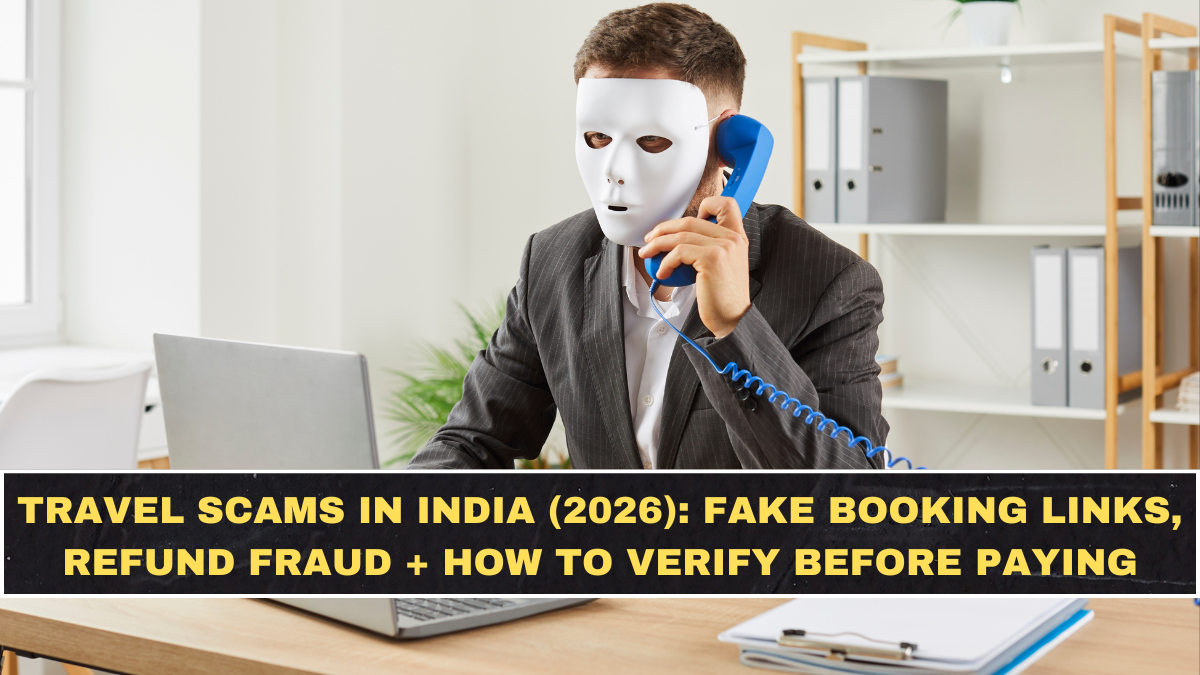
Travel is booming again, and so are travel scams. The reason this category keeps exploding is simple: travel bookings involve high-value payments, tight timelines, and emotional urgency. When you’re trying to lock a “limited seats” deal or fix a “booking failed” message, you’re more likely to act fast and think later. Scammers don’t need to be smarter than you; they only need you to be rushed for two minutes.
The modern travel scam doesn’t look like a shady website with broken English anymore. It often looks like a clean payment page, a convincing customer support voice, a “refund form,” or a WhatsApp-forwarded link with a familiar logo. The fraud is engineered around moments where people feel pressure: refund delays, cancellation panic, airline schedule changes, hotel overbooking, and last-minute festival or holiday travel. Your defense is not “being careful” in a vague way; it’s having a fixed verification routine that you follow every single time.
Why Travel Scams Spike So Hard in Real Life
Travel purchases have three ingredients scammers love: big amounts, complex policies, and confusion about who is responsible. People don’t fully understand cancellation charges, convenience fees, partial refunds, or time-bound offers. That confusion creates openings. Add to that a common habit—Googling “customer care number” in a hurry—and scammers get a direct path to you.
Another reason travel scams spread fast is social proof. A friend forwards a “deal,” a group shares a “new airline refund rule,” or a WhatsApp community posts “official support number.” The more it looks shared and familiar, the less people question it. In reality, forwarded messages are often the distribution network scammers rely on.
The Most Common Travel Scam Formats People Fall For
Travel scams usually fall into a few repeat patterns. Once you recognize the pattern, you stop seeing it as “my case is unique.” You start seeing it as a template, and templates are easy to block.
One major format is the fake booking link trap. You’re sent a link that looks like a normal checkout page, and you pay. The “PNR” or “booking ID” appears instantly, but it’s not connected to any real reservation. Another format is the “refund fraud” trick: you’re told your refund is stuck and you must fill a form, confirm UPI details, or “verify” by scanning a QR code. There are also fake customer care numbers, where the person on call convinces you to install a screen-sharing app, share OTP, or authorize a payment “to receive your refund.”
Red Flags That Should Immediately Stop You From Paying
Most victims ignore red flags because the scammer makes them feel like the red flag is normal. That’s manipulation. Use this list as a hard stop, not as “things to consider.”
A big red flag is being asked to pay into a personal bank account or a UPI ID that doesn’t clearly match the brand you think you’re dealing with. Another is being pressured with urgency like “only available for five minutes” or “refund window closes now.” Also treat it as suspicious if the support person asks you to share OTP, UPI PIN, or to scan a QR code for a refund. Refunds don’t require you to authorize a payment.
If someone asks you to install any app to “help complete the process,” especially screen sharing or remote access, assume it’s a scam until proven otherwise. Real travel companies solve issues through official app flows, email confirmations, and ticketing systems. They don’t need control of your phone.
The Verification Routine That Prevents Most Losses
People want a magic rule. There isn’t one. But there is a routine that blocks the majority of travel fraud because it removes the scammer’s advantage: speed. Here’s a routine you can repeat without needing tech knowledge.
First, verify the booking exists inside the official channel you normally use for that service. If you “booked a flight,” you should be able to see it under your trips or bookings inside the same platform account where you paid. Second, never trust a confirmation screenshot alone. Screenshots are free to fabricate. Third, for large payments, do a deliberate pause: step away for two minutes and re-check the payee details calmly. If you feel rushed, that’s the point.
Also, never verify through the same channel that contacted you. If a link came via WhatsApp, don’t click more WhatsApp links for “proof.” If a number called you claiming to be support, don’t accept their “verification steps.” You verify independently using your own saved contacts and your own app logins.
Refund Fraud: The One Mistake That Keeps Repeating
Refund scams work because people don’t understand the direction of money flow. A refund means money comes back to you without you authorizing a new outgoing payment. Scammers invert that logic and say you must “receive” money by entering a UPI PIN, scanning a QR, or approving a collect request. That is not a refund. That is you sending money.
Another trick is “small verification charge.” They claim a tiny debit is needed to activate a refund. Once you accept that logic, they repeat it with bigger amounts. If you remember only one line, remember this: you never pay money to get your own money back.
Fake Customer Care Numbers: The Fastest Way People Get Trapped
A huge number of travel losses start with a simple search: “refund customer care,” “airline helpline,” or “booking cancellation number.” Scammers push fake listings and sponsored-looking pages that appear trustworthy to tired users. Then the caller sounds professional, uses familiar words like “PNR,” “case ID,” and “processing team,” and you relax.
The real danger is what they ask next: OTP, remote access, or a payment authorization. The moment support asks you for anything that can move money out of your account, you’re not talking to support. You’re talking to someone trying to monetize your panic.
What To Do If You Already Paid
If you’ve already made a payment and you suspect it’s a scam, your next actions must be fast and structured. Don’t spiral. Don’t keep paying “to fix it.” Scammers love repeat payments because once you’ve paid once, you’re emotionally invested and easier to manipulate.
Start by collecting key details: transaction IDs, time, amount, payee handle or bank details, and screenshots of the conversation. Then immediately inform your bank through official banking channels and report the transaction as suspicious. If you installed any app at someone’s request, uninstall it and review your phone permissions. Change your device lock and secure your email if you shared anything sensitive. Finally, warn your close contacts if the scam involved WhatsApp impersonation, because scammers often pivot to your network when you stop cooperating.
How to Book Safely Without Becoming Paranoid
The goal is not fear. The goal is consistency. Keep bookings inside platforms you can access with your own login, keep confirmations in email/app history, and avoid paying via links sent on chat. For deals forwarded by friends, treat them as “leads,” not as purchase instructions. You can always search the deal inside the official app yourself rather than trusting the link.
For family members, especially parents, simplify the safety rules. Don’t dump ten warnings. Give three rules: never install an app for refunds, never share OTP/UPI PIN, and never scan a QR for receiving money. Combine that with a habit: call back using a saved number if anything feels urgent.
Conclusion
The biggest danger in travel fraud is not lack of intelligence, it’s time pressure. Scammers win when you’re rushing, tired, or trying to “fix it quickly.” If you follow a basic verification routine and understand how refund fraud works, you block most attacks automatically. That’s why travel scam India 2026 patterns keep succeeding against smart people: the scam targets emotions, not IQ.
Your protection is boring and repeatable: verify bookings inside official accounts, refuse QR/collect requests for refunds, and never trust customer care numbers found through random searches in a panic. Do that consistently and travel scam India 2026 becomes far less likely to cost you money, time, and peace of mind.
FAQs
What is the most common travel scam in India right now?
The most common patterns are fake booking links, fake customer care numbers, and refund scams that trick users into authorizing a payment in the name of receiving money.
Do refunds ever require scanning a QR code or entering a UPI PIN?
No. A real refund does not require you to approve a new outgoing payment, scan a QR, or share a PIN. Those steps are typical scam mechanics.
How can I quickly verify if my booking is real?
A genuine booking should appear inside your account’s booking history in the platform or app you used, and should match your payment confirmation and trip details consistently.
What should I do if I mistakenly installed a screen-sharing app for a refund?
Uninstall it immediately, review app permissions, secure your phone lock, and check bank/UPI activity. If you shared sensitive details or see unknown transactions, report it through official banking channels right away.
How many times should I use the main keyword travel scam India 2026 in an article?
Use it only where it fits naturally, typically a few times across the article. The goal is clarity and trust, not repetition.