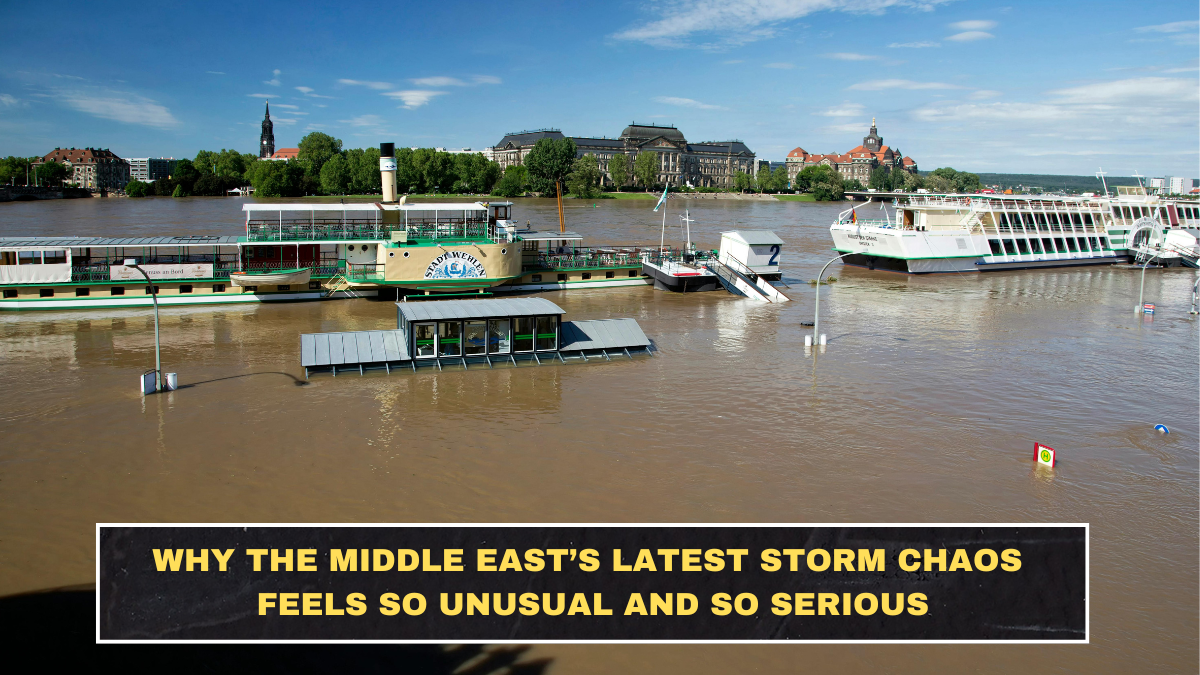
The latest Middle East storm chaos matters because this was not a routine rain spell in a dry region. A rare multiday system brought severe thunderstorms, flooding, damaging winds, and large hail across parts of the United Arab Emirates, Saudi Arabia, Oman, and Qatar. The Guardian’s weather summary reported rainfall totals of up to 150 mm in parts of the region, while Jebel Yanas in the UAE recorded 244 mm, far above the UAE’s typical annual rainfall of around 60 to 100 mm.
What made this storm so unusual
The core reason is meteorological, not mystical. The Guardian reported that a strong jet stream helped create a deep low-pressure system that pulled moist air from the Indian Ocean into the Arabian Peninsula. That combination created the instability needed for repeated thunderstorms over places that are usually much drier. The Washington Post described the setup as unusually severe for the region, with a storm pattern more similar to strong convective systems seen in wetter parts of the world.
Why the UAE and Saudi Arabia were hit so hard
The event was serious because it combined several hazards at once rather than delivering just one bad downpour. The Guardian reported 80 mph wind gusts, large hail, lightning, and widespread flooding around heavily populated areas including Dubai and Abu Dhabi. India Today also reported thick hail accumulation in parts of the UAE, while broader regional coverage described impacts extending into Saudi Arabia and neighboring Gulf states. In dry countries, urban drainage, road design, and public routines are often less prepared for several days of intense convective weather in a row.
Why rare storm events in dry regions are so disruptive
The damage risk rises quickly when intense rain falls on hard, dry ground and dense urban surfaces. Water runs off faster, flash flooding builds quickly, and transport systems struggle. The Guardian reported flooding in Doha, while UAE forecasting coverage warned of heavy rain, strong winds, thunder, and the risk of flooding during the peak of the system. In blunt terms, a place does not need a monsoon climate to suffer serious flood disruption. It only needs more rain than its infrastructure can absorb in a short time.
The climate angle should not be exaggerated, but it also should not be ignored
It would be lazy to claim one storm “proves” climate change. That is not how this works. But it is equally lazy to pretend climate has nothing to do with rising concern over extreme rainfall in the region. Reuters reported in late 2025 that the Middle East and North Africa are warming at roughly twice the global average, and that intense rainfall has already been contributing to flash flooding in countries including Saudi Arabia, Bahrain, and the UAE. The Guardian also noted that this type of intense storm fits a broader pattern of more extreme rainfall events in a warming world.
What the event shows at a glance
| Factor | Reported detail | Why it matters |
|---|---|---|
| Rainfall in parts of region | Up to 150 mm | Huge total for arid areas |
| UAE extreme reading | 244 mm at Jebel Yanas | Far above normal annual rainfall in many UAE locations |
| Wind gusts | Up to 80 mph | Adds damage risk beyond flooding |
| Hazard mix | Flooding, hail, lightning, strong winds | Multi-risk event is harder to manage |
| Weather driver | Deep low pressure plus imported moisture | Explains why the storm was so intense |
These numbers show why the story felt so dramatic. This was not simply “rain in the desert.” It was a severe regional weather event with rainfall and storm dynamics that dry-zone infrastructure does not handle easily.
Why this deserves more attention now
The real lesson is not that every Gulf storm will become catastrophic. It is that dry-region extremes deserve more respect than they usually get. Reuters’ broader climate reporting and the recent Gulf storm coverage point in the same direction: extreme heat is not the region’s only climate risk. Intense rainfall, flash flooding, and compound weather shocks are becoming more important too. That matters for airports, roads, emergency planning, and urban design across the Gulf.
What readers should watch next
The useful signals are straightforward:
- whether more heavy-rain events cluster in the same season
- whether Gulf governments tighten flood and drainage planning
- whether airport, road, and school disruptions become more frequent during storm alerts
- whether forecasters keep highlighting unusually strong low-pressure systems over the region
Conclusion
The Middle East’s latest storm chaos felt so unusual because it combined rare atmospheric ingredients with heavy impacts in places that are not built for repeated severe rain. The event brought flood risk, hail, wind, and lightning across multiple Gulf countries, and the rainfall totals alone were enough to make it serious. The smarter takeaway is not panic. It is realism: dry regions can face dangerous storm extremes too, and pretending otherwise is just bad reading of the evidence.
FAQs
What caused the Middle East storm chaos in March 2026?
A strong jet stream and a deep low-pressure system pulled moist air into the region, helping produce severe thunderstorms and heavy rain over several days.
Which countries were affected?
Reporting highlighted impacts across the UAE, Saudi Arabia, Oman, and Qatar, with flooding and severe storms affecting major urban areas as well.
How unusual was the rainfall?
Very unusual for the region. The Guardian reported up to 150 mm in some areas and 244 mm at Jebel Yanas in the UAE, far above normal annual rainfall levels for many locations there.
Does this storm prove climate change?
No single storm proves climate change by itself. But Reuters and other reporting show the region is warming quickly and that intense rainfall events in Gulf countries are becoming a more serious concern.