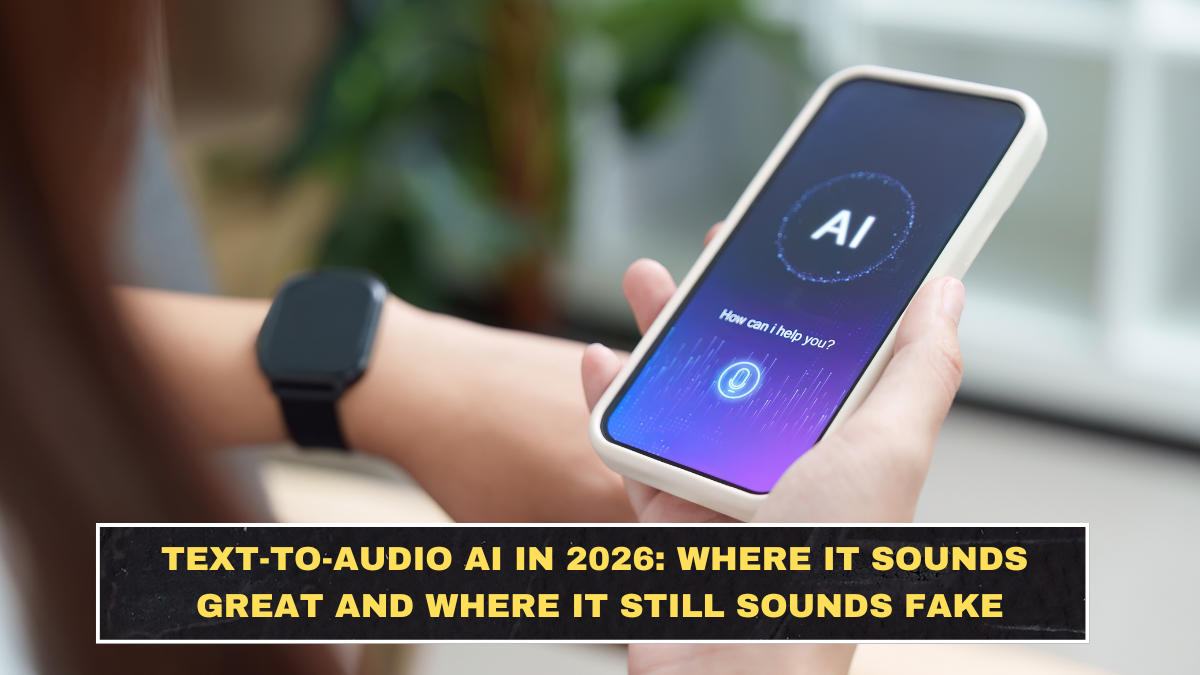
Text-to-audio AI is no longer just a robotic text-to-speech category. In 2026, major platforms are pushing more natural intonation, emotional delivery, low-latency streaming, and custom voice features. ElevenLabs says its TTS platform offers lifelike speech with nuanced intonation and emotional awareness across dozens of languages, Google positions Chirp 3 HD voices around realism and emotional resonance, and Azure says its HD voices can detect sentiment and adjust tone in real time.
That sounds impressive, and some of it is. But people are still fooling themselves when they think “sounds more human” means “sounds fully human.” These tools are now good enough for many creator and business uses, but they still break under emotion, dialogue realism, and long-form consistency more often than marketers admit.
What does text-to-audio AI do well now?
It is strongest for narration-style content. Explainer videos, audiobooks, training modules, customer service flows, app voiceovers, and social media narration are all realistic use cases now. ElevenLabs explicitly markets TTS for ads, audiobooks, podcasts, and presentations, while Azure offers standard and custom voices across 100+ languages and locales.
It is also much better at multilingual output than older TTS systems. ElevenLabs says its platform supports 70+ languages overall and 32 languages in its TTS documentation, while Google says Chirp 3 HD voices support many languages and styles, including real-time and standard use cases. That makes text-to-audio AI far more practical for global creator workflows than it was just a couple of years ago.
Where does synthetic audio still sound wrong?
The biggest weakness is emotional precision. A voice can sound smooth and still feel fake. It may overperform sadness, flatten excitement, or miss the subtle rhythm that makes real speech believable. Azure claims its HD voices can detect emotion in input text and adapt tone in real time, and ElevenLabs keeps emphasizing emotional awareness, but these claims themselves reveal the problem: emotion is still something vendors are actively trying to solve, not something perfectly solved already.
Long-form consistency is another issue. A short sample may sound excellent, but longer scripts can still drift in pacing, emphasis, or vocal energy. Synthetic speech is much better than before, yet “great demo voice” and “fully believable production voice” are still not the same thing. OpenAI’s next-generation audio launch focused on more customizable, expressive speech, which is progress, but even that points to an industry still improving rather than one that has finished the job.
Which strengths and weaknesses matter most?
| Area | Where text-to-audio AI works well | Where it still struggles |
|---|---|---|
| Narration | Explainers, training, audiobooks, social clips | Dialogue-heavy scenes can feel artificial |
| Multilingual use | Broad language support and localization | Accent and nuance can still vary |
| Emotion | Better than older TTS systems | Fine emotional control still sounds uneven |
| Speed | Fast generation and streaming support | Cheap speed can still reduce quality |
This is the real buying logic. Do not ask whether a tool sounds amazing in isolation. Ask whether it sounds convincing for your actual use case.
How should creators choose a text-to-audio AI tool?
Choose based on workflow, not hype. If you care most about lifelike creator voiceovers and strong consumer-facing demos, ElevenLabs is clearly targeting that market. If you need enterprise scale, language coverage, or integration into Microsoft systems, Azure is more relevant. If you want Google Cloud integration, HD voices, and custom voice options, Chirp 3 is the clearer fit.
Also check price honestly. Google’s pricing page lists Chirp 3 HD voices at $30 per 1 million characters after the free tier, which matters for high-volume production. Cheap generation is meaningless if you still need heavy manual cleanup after every output.
Is text-to-audio AI worth using in 2026?
Yes, if you use it where it is already strong. It is now good enough for narration, education, product walkthroughs, creator content, support flows, and many multilingual needs. Realtime systems are also improving fast, with OpenAI’s Realtime API and related guidance emphasizing smoother, more natural voice experiences.
But the honest answer is this: it still sounds fake when people push it beyond its comfort zone. Emotional subtlety, truly natural conversation, and consistently believable long-form performance are improving, not finished. That is the part marketers keep softening.
FAQs
Is text-to-audio AI good enough for professional use?
Yes, for many narration and business uses such as training, voiceovers, audiobooks, and support flows. Multiple major platforms now offer high-quality neural or generative voices for production use.
What is the biggest weakness of AI voice tools?
Emotional realism and long-form consistency are still the biggest weak points. Voices may sound polished but still feel unnatural over time or in complex dialogue.
Which platforms are leading in text-to-audio AI?
ElevenLabs, Google Cloud TTS with Chirp 3 HD, Azure Speech, and newer OpenAI audio models are among the most important current players.
Is text-to-audio AI getting cheaper?
Some platforms offer free tiers, but serious usage still has real cost. Google, for example, lists Chirp 3 HD voices at $30 per 1 million characters after free usage.
Click here to know more