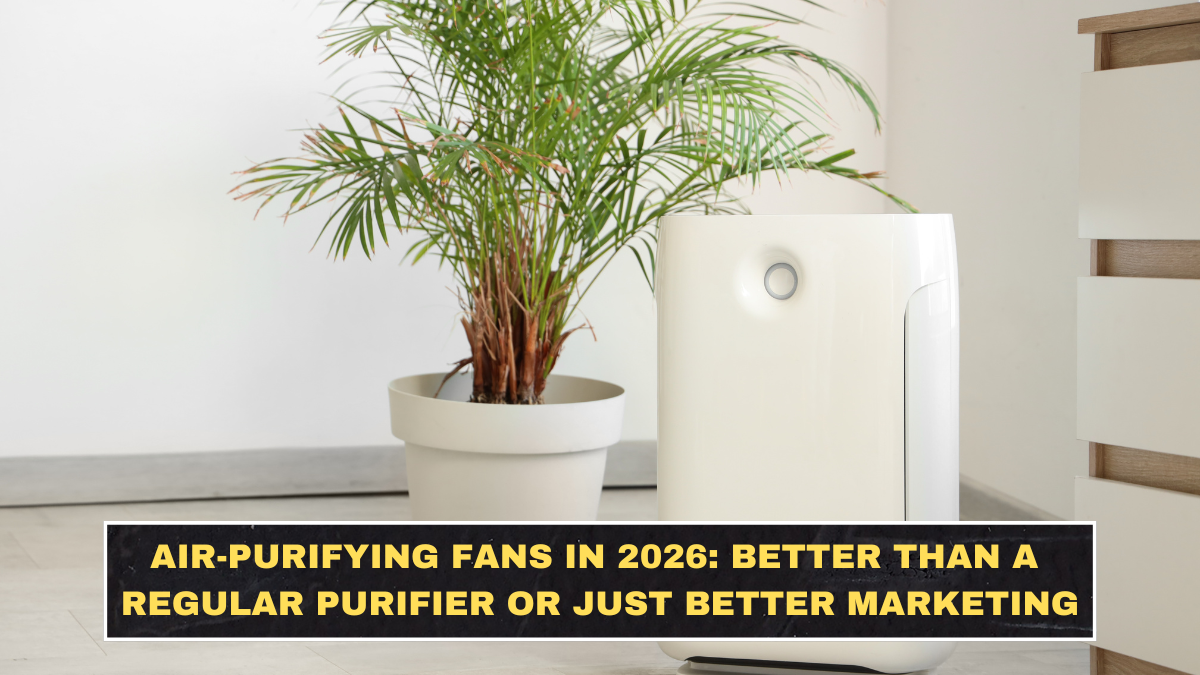
An air-purifying fan is a combo device that tries to do two jobs at once: move air like a fan and clean air like a purifier. In most cases, the cleaning side relies on a particulate filter such as HEPA plus, sometimes, an activated carbon layer for odors or gases. Dyson, one of the best-known brands in the category, describes its purifier-fan systems as using sealed filtration with HEPA and carbon filters while also projecting cleaned air back into the room.
That sounds efficient, but buyers often confuse airflow with purification. They are not the same thing. A fan can make a room feel fresher just by moving air around. A purifier actually needs to pull air through a filter and deliver enough cleaned air to matter. The U.S. EPA says portable air cleaners should be judged partly by Clean Air Delivery Rate, or CADR, because CADR reflects how quickly a unit filters air for a given room size.
Why are these products getting so much attention in 2026?
They are getting attention because they sell convenience. People want fewer gadgets, cleaner-looking rooms, and something that can help with comfort and air quality at the same time. That pitch is easy to understand, especially for smaller homes, bedrooms, and living spaces where buyers do not want both a separate purifier and a separate fan. The broader air-purifier market is also still growing, with recent market research estimating the global market at about $19.47 billion in 2026 and projecting further expansion through 2033.
The trend also benefits from allergy worries, wildfire smoke concerns, pet dander, and general indoor-air anxiety. But attention is not proof. A product category can grow quickly because it sounds smart, not because it is the best-performing option for most homes. That is the part buyers keep getting wrong.
Do air-purifying fans actually clean air well?
Yes, some of them do clean air meaningfully, especially if they use true sealed filtration and have enough clean-air output for the room. HEPA-based air cleaners are still the most credible mainstream option for removing airborne particles, and EPA guidance continues to point buyers toward HEPA-style filtration and room-appropriate CADR. Studies also show that HEPA air cleaners can reduce indoor particulate pollution and may support modest health benefits when used consistently at home.
But here is the part marketing avoids: combo devices do not automatically outperform dedicated purifiers. Blueair’s 2025 explainer, which is obviously not neutral but is still directionally useful, states that purifier-fan combos typically deliver lower CADR than a dedicated purifier at the same price point. Independent testing coverage points in the same direction. HouseFresh’s late-2025 roundup said that if you want the best performance, separate purifier and fan units usually make more sense than a combo.
What matters more than the “fan” label?
CADR matters more. Room-size matching matters more. Filter quality matters more. A device can look sleek and blow air strongly while still cleaning air too slowly for the space. EPA and ENERGY STAR both emphasize CADR as one of the most useful comparison metrics because it indicates how fast a purifier can deliver cleaned air. Higher CADR generally means faster particle removal and better suitability for larger rooms.
This is where buyers fool themselves. They stand in front of a product demo, feel the breeze, and assume it must be cleaning aggressively. That is dumb. Strong airflow can feel impressive even when filtration performance is only average. Air cleaning is about filtered air volume, not vibes.
How do air-purifying fans compare with standalone purifiers?
| Factor | Air-Purifying Fan | Standalone Purifier |
|---|---|---|
| Main appeal | Two functions in one device | Better value if air cleaning is the top priority |
| Space saving | Strong | Moderate |
| Cooling airflow | Yes, usually | Limited or none |
| Best metric to compare | CADR and room coverage | CADR and room coverage |
| Likely performance per dollar | Often lower | Often better |
That is the comparison that actually matters. If your main goal is cleaner air, a standalone purifier is often the smarter buy because more of the cost goes toward filtration performance instead of design, airflow projection, or combo convenience. If your main goal is reducing clutter and you genuinely want both functions in one product, the combo may be worth it.
Who should buy an air-purifying fan now?
It makes sense for buyers with limited space, a preference for minimalist setups, and moderate air-quality needs in small to medium rooms. It can also make sense for people who were already planning to buy both a fan and a purifier and are willing to accept some performance tradeoff for convenience. Dyson and similar brands are basically selling that trade: less clutter, more design, one-device simplicity.
It makes less sense for people dealing with serious smoke, heavy allergies, larger rooms, or the need for the best particle removal possible at a given budget. Those buyers should care less about the combo concept and more about raw clean-air performance. WIRED’s 2026 purifier testing and other recent review roundups still focus mainly on dedicated purifiers when performance is the priority.
What mistakes do buyers keep making?
The first mistake is buying on design instead of numbers. The second is ignoring room size. The third is treating HEPA claims like the whole story when CADR and actual air turnover matter just as much. The fourth is assuming combo means value. Sometimes combo means compromise. EPA guidance is clear that room-fit and clean-air delivery are central to choosing an effective air cleaner.
Another blind spot is ozone and ionizer nonsense. IQAir’s explainer notes that ion-generating devices can create confusion because CADR alone does not tell you whether particles are truly removed or simply deposited elsewhere, and ozone-producing approaches raise obvious concerns. That means buyers should favor mechanical filtration and be skeptical of flashy purification claims that sound futuristic but get vague about filters.
Conclusion
Air-purifying fans in 2026 are not useless. Some are legitimate air cleaners that also function as fans, and they can make sense for buyers who want convenience, fewer devices, and acceptable performance in smaller or mid-size rooms. HEPA-style filtration, sealed systems, and proper room matching still matter, and those basics are more important than branding.
But for pure air cleaning value, standalone purifiers still usually make more sense. That is the blunt truth. If you care most about cleaner air, buy for CADR, filter quality, and room fit. If you care most about design and convenience, then a purifier-fan combo may be worth it. Just stop pretending those are the same buying goal.
FAQs
Are air-purifying fans as effective as regular air purifiers?
Sometimes, but often not at the same price level. Combo products can work well, but dedicated purifiers usually deliver stronger cleaning performance per dollar when air quality is the top priority.
What should matter most when buying one?
CADR, room-size suitability, filter type, and whether the filtration system is properly sealed should matter more than the product looking premium or blowing strong airflow.
Are HEPA air-purifying fans good for allergies?
They can help because HEPA-based air cleaners are effective at reducing airborne particles such as dust, pollen, and similar allergens. But the unit still needs enough clean-air output for the room.
Who should skip this category?
People with large rooms, strong smoke concerns, or serious allergy needs should usually prioritize a strong standalone purifier instead of paying extra for a combo format that may clean more slowly.