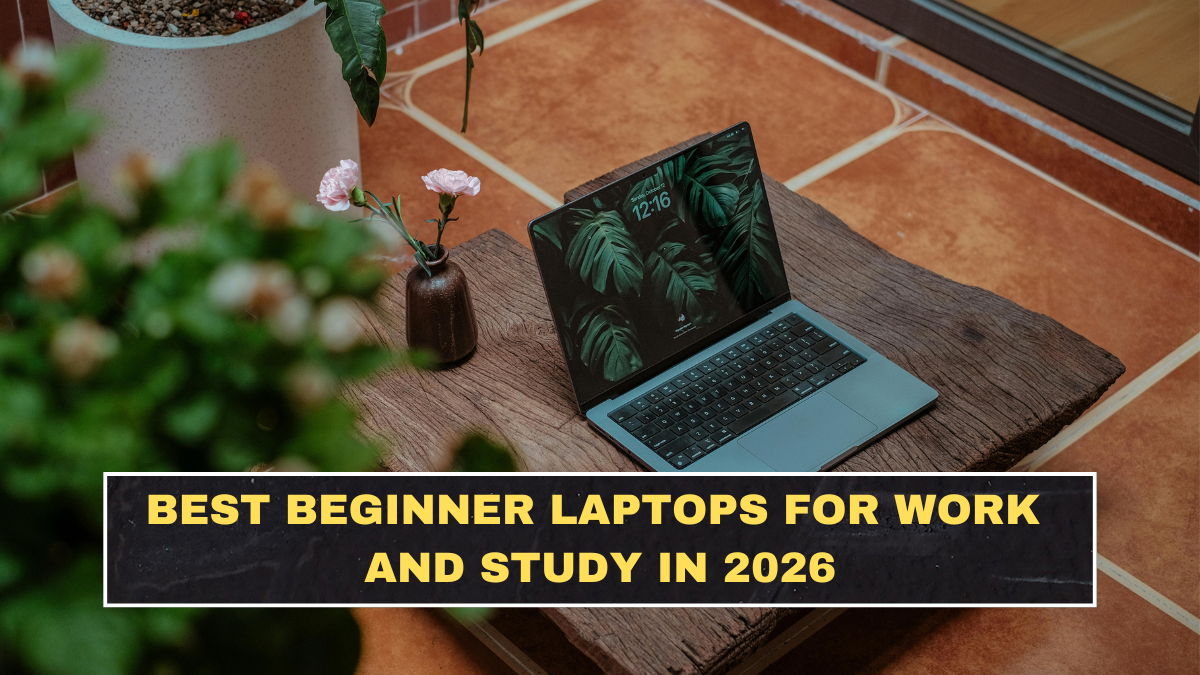
Most beginner laptop advice is garbage because it treats buyers like they need a machine for video editing, gaming, coding, design, and AI experiments all at once. Most people do not. For work and study, the goal is much simpler: a laptop that feels fast enough for daily tasks, has decent battery life, a usable keyboard, and enough memory and storage that it does not become annoying in six months. Microsoft’s current laptop buying guide still frames student and productivity laptops around long battery life, portability, and multitasking, while Google’s Chromebook Plus baseline now requires at least 8GB RAM, 128GB storage, a Full HD IPS display, and a modern processor. That alone tells you where the real minimum standard has moved in 2026.
What should a beginner laptop actually be good at?
A beginner laptop should handle browsing, video calls, documents, spreadsheets, streaming, online classes, email, and light multitasking without freezing or making you wait every few minutes. That is it. Microsoft’s Windows laptop guidance emphasizes that more RAM and more storage help multitasking, and its current buying guides keep pushing battery life, portability, and secure login as practical advantages for school and work use. The real standard is not “most powerful.” It is “least frustrating for normal daily use.”
Which specs matter most in 2026?
In 2026, the safe beginner baseline is 8GB RAM and 128GB SSD storage at minimum, but 16GB RAM and 256GB SSD is a much smarter target if the budget allows. Google’s Chromebook Plus requirements lock in 8GB and 128GB as the modern floor for a strong web-focused laptop, and Microsoft’s laptop guidance also highlights higher RAM and storage for smoother multitasking. In plain language, 4GB RAM machines are mostly a false economy now unless the use case is extremely light.
| Feature | Minimum that still makes sense | Smarter target for 2026 |
|---|---|---|
| RAM | 8GB | 16GB |
| Storage | 128GB SSD | 256GB SSD or more |
| Display | Full HD | Full HD IPS or better |
| Processor | Modern Core i3 / Ryzen 3 / equivalent | Core i5 / Ryzen 5 / stronger equivalent |
| Battery | Enough for classes or work blocks | All-day battery that reduces charger stress |
| Webcam | 1080p preferred | 1080p with decent noise handling |
Why is 8GB RAM now the real entry level?
Because modern work and study are heavier than people admit. A few browser tabs, a video call, documents, cloud storage, music, and messaging apps can already push a weak machine into sluggishness. Google’s Chromebook Plus standard requires 8GB or more, which is a blunt signal that lower memory is no longer a comfortable baseline for everyday productivity. If a laptop still ships with too little memory and calls itself beginner-friendly, it is probably beginner-hostile in practice.
Should beginners buy Windows, Chromebook, or something else?
That depends on what the work actually is. A Windows laptop is usually the safest all-rounder because it handles office work, browser use, local files, common software, and more flexibility across work and school situations. Microsoft’s buying guide keeps Windows laptops positioned across student and productivity use cases for exactly that reason. A Chromebook makes more sense when the workload is mostly browser-based, app-light, and cloud-centered. Chromebook Plus devices are now much stronger than older budget Chromebooks, but they are still better for users whose work lives mostly online rather than in specialized desktop software.
What features are worth paying extra for?
Pay extra for more RAM, better battery life, a sharper display, and a better keyboard before paying extra for shiny gimmicks. Microsoft’s 2026 AI PC guide talks about newer local AI features and NPUs, but for a true beginner laptop, those are secondary unless the buyer already knows they want those workflows. What matters more for most students and office users is whether the laptop opens quickly, stays quiet, lasts through the day, and is pleasant to type on. Fancy branding is less useful than one extra step up in memory or battery.
Are Chromebooks finally good enough for serious beginners?
Some are, yes. The problem is that people still judge them by older weak models. Chromebook Plus now guarantees stronger minimum specs, including modern processors, 8GB+ RAM, 128GB+ storage, Full HD IPS displays, and 1080p webcams. That makes them far more realistic for students, writing-heavy users, and general web-based work than the old bargain-bin Chromebook era. The catch is obvious: if you rely on Windows-only software or heavier desktop workflows, a Chromebook can still become the wrong choice fast.
What mistakes do first-time laptop buyers make?
The biggest mistake is buying the cheapest machine with the biggest discount sticker. That usually means weak memory, poor storage, and a laptop that feels old too soon. Another mistake is overbuying for imaginary future needs. If the real job is email, research, video calls, docs, and streaming, you do not need a pseudo-creator machine with premium specs you will never use. A third mistake is ignoring the screen and keyboard. A laptop for work and study is something you stare at and type on constantly. If those two things are bad, the rest of the machine does not save it.
How should a beginner choose the right laptop in 2026?
Use a simple decision rule. If the work is mostly browser, docs, classes, and streaming, a strong Chromebook Plus can be enough. If the user needs more software flexibility, better local app support, or room to grow, a Windows laptop with at least 8GB RAM and 256GB SSD is the safer choice. And if the budget can stretch to 16GB RAM, that is usually a better long-term upgrade than chasing flashy features. The smartest beginner laptop is not the one with the most hype. It is the one that stays useful longest without wasting money.
Conclusion?
The best beginner laptops for work and study in 2026 are the ones that meet modern baseline needs without pretending every buyer is a power user. In practical terms, that means 8GB RAM minimum, 128GB SSD minimum, Full HD display, decent battery life, and a machine built for normal multitasking. Windows is still the safer all-purpose choice, while Chromebook Plus has become a much stronger option for web-first users. Stop buying based on brand noise or discount bait. Buy the laptop that fits your actual work.
FAQs
How much RAM should a beginner laptop have in 2026?
At least 8GB RAM, with 16GB being a smarter long-term choice for smoother multitasking. Google’s Chromebook Plus baseline now starts at 8GB, which reflects the modern minimum more honestly.
Is 128GB storage enough for work and study?
It can be enough for lighter users, especially on cloud-first systems, but 256GB SSD is usually the safer target because it leaves more room for files, apps, and updates.
Are Chromebooks good for students now?
Yes, especially Chromebook Plus models, which now require stronger specs like 8GB RAM, 128GB storage, Full HD IPS displays, and 1080p webcams.
Should beginners buy an AI PC?
Usually only if the budget is already comfortable and the buyer actually cares about those features. For most beginners, RAM, battery life, display quality, and keyboard comfort matter more first.
What is the biggest beginner laptop buying mistake?
Buying too cheap and ending up with weak specs that feel slow almost immediately. Low price matters, but false economy matters more.
Click here to know more