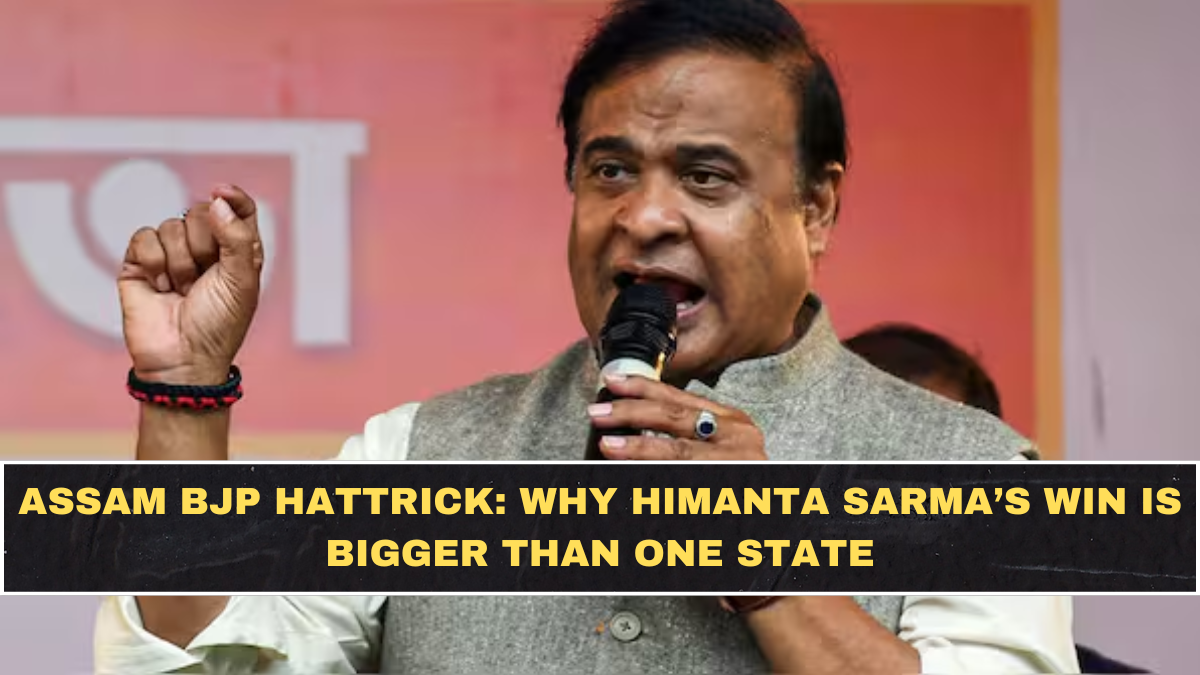
Assam has delivered a clear political message in 2026: BJP is no longer just strong in the state; it has become the dominant force. According to the Election Commission of India’s latest Assam results, BJP won 82 seats in the 126-member Assembly, while Congress finished far behind with 19 seats. With allies AGP and BPF winning 10 seats each, the BJP-led bloc has secured a massive majority.
This result gives BJP a historic third consecutive term in Assam, making the state one of the party’s strongest political fortresses in the Northeast. The scale of the win matters because Assam was not just a routine election; it was a test of Himanta Biswa Sarma’s leadership, BJP’s regional strategy and Congress’s comeback claims. The result shows that voters did not simply return BJP to power; they strengthened its hold.
Why Is This Hattrick Huge?
A third straight win changes how a party is seen in any state. In Assam, it tells us that BJP has moved beyond anti-Congress sentiment and built its own durable voter base. The party has combined welfare delivery, identity politics, local leadership and strong organisation to create a model that keeps working across elections.
Himanta Biswa Sarma’s personal win added more force to the result. Times of India reported that he won Jalukbari with 1,27,151 votes, defeating Congress candidate Bidisha Neog by a margin of 89,434 votes. That kind of margin is not just a constituency win; it signals personal dominance and strengthens his claim as BJP’s most powerful Northeast face.
What Do The Numbers Show?
| Party | Seats Won | What It Means |
|---|---|---|
| BJP | 82 | Clear single-party dominance |
| Congress | 19 | Weak opposition performance |
| BPF | 10 | Important BJP-side ally strength |
| AGP | 10 | Regional support within NDA |
| AIUDF | 2 | Reduced influence |
| Raijor Dal | 2 | Limited opposition space |
| TMC | 1 | Minor entry, no major impact |
The numbers are brutal for Congress because BJP alone crossed the majority mark of 64 without needing allies. Indian Express reported BJP winning 82 seats and Congress only 19, confirming the scale of the ruling party’s victory. This means the Assam result is not only a BJP-led alliance win; it is also a strong individual BJP performance.
Why Did Himanta Win So Big?
Himanta Biswa Sarma’s biggest advantage is that he has built a strong local leadership image instead of depending only on national BJP branding. His politics mixes aggressive messaging, welfare delivery, administrative control and strong communication. Whether people agree with his style or not, the result shows that his formula has worked electorally in Assam.
Another reason is BJP’s deep organisation across the state. The party did not look dependent on one caste, one region or one issue. It expanded through alliances, booth-level management and targeted messaging. Congress tried to position itself as an alternative, but the final result shows it failed to convert dissatisfaction into a serious anti-BJP vote.
Why Did Congress Collapse Again?
Congress’s biggest failure in Assam is not just losing; it is failing to look like a credible government-in-waiting. NDTV reported that polling saw a high turnout of 85.96% among more than 2.50 crore registered voters, which means people did participate actively. High turnout did not automatically help the opposition, which suggests BJP’s ground machinery handled the election far better.
The party also suffered symbolic setbacks. Reports said Congress leader Gaurav Gogoi lost from Jorhat, while Hindustan Times reported that Assam Congress chief Jitendra Singh quit after NDA secured a two-thirds majority. These developments make the defeat look deeper than numbers because they point to leadership pressure and organisational weakness.
What Made BJP’s Strategy Work?
- Strong CM face: Himanta Biswa Sarma gave BJP a powerful regional anchor.
- Alliance management: AGP and BPF helped widen BJP’s reach across communities.
- Clear messaging: BJP mixed development, identity and security politics effectively.
- Weak opposition: Congress failed to build a convincing alternative government image.
- Booth strength: BJP’s ground organisation converted support into seats efficiently.
This is why Assam is now bigger than a state election story. BJP has shown that it can hold power for three terms in a complex, identity-sensitive northeastern state. For national politics, this strengthens the party’s claim that its governance model is not limited to Hindi-belt states.
Is Himanta Now Bigger Nationally?
Yes, Himanta’s national profile has grown further after this result. He was already one of BJP’s most visible chief ministers because of his sharp speeches, aggressive positioning and Northeast management. A third straight BJP win in Assam gives him a stronger platform inside the party and makes him more important for future national campaigns.
But this also increases pressure. A leader who wins this big cannot blame past governments forever. Assam now needs delivery on jobs, flood management, infrastructure, ethnic peace and youth aspirations. If Himanta wants to convert this win into long-term legacy, he must prove that political dominance can also produce cleaner and more stable governance.
What Is The Final Takeaway?
Assam’s 2026 result is a major BJP victory because the party has won a third consecutive term and crossed the majority mark on its own. BJP’s 82-seat performance, combined with ally strength, gives Himanta Biswa Sarma a powerful mandate. Congress, meanwhile, has been pushed into a serious crisis with only 19 seats and major leadership questions.
The blunt truth is that Assam has become BJP’s strongest northeastern fortress. Himanta has proved his electoral power again, but the next challenge is governance, not celebration. If BJP delivers on jobs, floods, peace and development, this hattrick can become a long-term model. If it becomes arrogant, the same voters can punish it later.
Frequently Asked Questions
Who won the Assam election 2026?
BJP won the Assam Assembly election 2026 with 82 seats, according to the Election Commission of India. Congress finished with 19 seats, while BJP allies AGP and BPF won 10 seats each. This gives the BJP-led side a strong majority in the 126-member Assembly.
Did BJP get a third term in Assam?
Yes, BJP has secured a third consecutive term in Assam. The party not only returned to power but also crossed the majority mark on its own. This makes the Assam result politically important for BJP’s wider Northeast strategy and Himanta Biswa Sarma’s leadership image.
How big was Himanta Biswa Sarma’s win?
Himanta Biswa Sarma won the Jalukbari seat with 1,27,151 votes, defeating Congress candidate Bidisha Neog by 89,434 votes. This huge margin strengthened his position as BJP’s strongest Assam leader. It also gave him a larger national profile within the party.
Why did Congress lose badly in Assam?
Congress lost badly because it failed to look like a strong alternative to BJP. The party could not match BJP’s organisation, leadership clarity or alliance strategy. Symbolic losses and leadership pressure after the result made the defeat look even more damaging for the party.