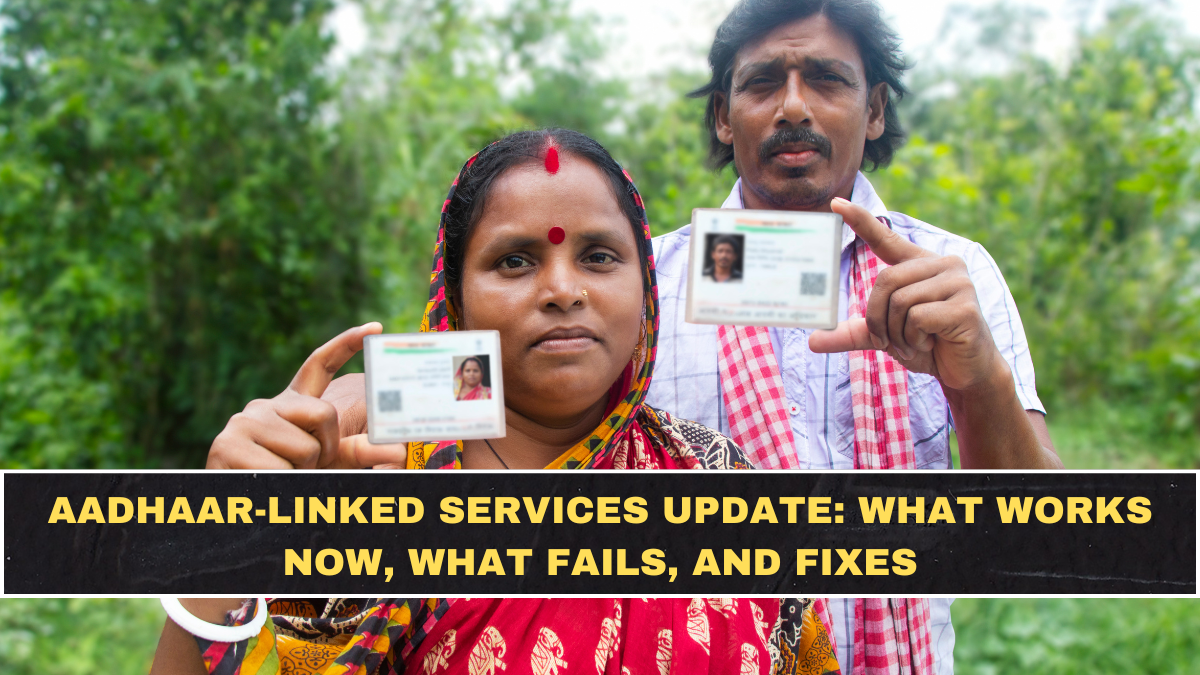
When people say Aadhaar update services stopped, most of the time it’s not that “Aadhaar got blocked” or “the government shut something down.” It’s usually a verification chain breaking at one weak point: your mobile number isn’t current, your details don’t match across systems, your biometrics don’t authenticate, or your update request is still in processing. The frustrating part is that the error message is often vague, so people keep trying the same thing again and again and burn time.
The smarter way to handle it is to treat Aadhaar-linked failures like a checklist problem, not a panic problem. One small mismatch can make multiple services fail at once—bank KYC, SIM verification, benefit authentication, or online identity checks. Fix the root cause and everything starts working again, instead of doing random attempts that don’t change anything.
Why Aadhaar-Linked Services Fail So Suddenly
Aadhaar-based verification depends on exact matching and successful authentication. If your name spelling differs between Aadhaar and another record, if your date of birth format doesn’t align, or if your address is outdated in one system, you can get blocked at the verification step even if you’ve used the service before. This feels “sudden” because you didn’t change anything recently, but the system’s checks can become stricter over time.
Another common reason is that authentication is not just about your Aadhaar number—it’s about your ability to prove it’s you in that moment. OTP failures happen when the Aadhaar-linked mobile number is old, inactive, or not in your possession. Biometric failures happen due to worn fingerprints, sensor quality, dry skin, or age-related changes. If you’re seeing repeated failures across different places, it’s a signal that your authentication method—not the service—is the issue.
What Still Works Reliably (If Your Basics Are Correct)
Most people can still complete Aadhaar-linked verification smoothly when two things are solid: your Aadhaar details are accurate and your Aadhaar mobile number is accessible. OTP-based flows work best when your SIM is active, network is stable, and you’re entering details exactly as recorded. Many services that offer “verify via OTP” are built for speed, but they collapse instantly if your mobile number isn’t linked or if your account is flagged for mismatch.
For in-person verification, biometric authentication can be very reliable when the device is good and your fingerprints read clearly. If you usually succeed at biometrics but fail only in one location, the problem may be the device or operator method. If you fail everywhere, your fingerprints or biometric settings are the likely cause, and you should switch to another allowed method where possible instead of repeating failed biometric attempts.
The Biggest Reasons “Verification Failed” Keeps Showing Up
The most common cause is a demographic mismatch. People underestimate how strict “exact match” can be. Even small differences like “Kumar” vs “Kumarji,” spacing changes, initials, or a slightly different date format can trigger rejection. The second big cause is a mobile mismatch: you think your number is linked, but the system still sends OTP to an older number you no longer use.
Another major cause is biometric lock. Many users lock their biometrics as a safety feature and forget they did it. That’s great for preventing misuse, but it will cause biometric authentication to fail until you unlock it. Finally, there’s update processing. If you recently changed name, address, date of birth, or mobile number, the update may still be under verification, and services may fail until the status settles. This is why Aadhaar update services stopped often appears right after people attempt a correction.
Fix Checklist: Do These in Order (Don’t Randomly Try Things)
Start with what you can control fastest and what breaks most services.
-
Confirm you have access to the mobile number linked with Aadhaar, not just your current number.
-
Check whether your Aadhaar details (name, DOB, gender) match what the service expects based on their records.
-
If biometric authentication keeps failing, switch to OTP where allowed instead of retrying biometrics repeatedly.
-
If OTP keeps failing, don’t keep resending it endlessly—focus on mobile linking and network stability.
-
If you recently submitted an Aadhaar update request, assume processing time is a factor and plan alternate verification methods in the meantime.
If the service is a bank, SIM verification, or benefit authentication, ask them what exact field is mismatching. Don’t accept vague lines like “system issue.” The mismatch usually exists in one specific field, and once you know which field, the fix becomes straightforward instead of guesswork.
Biometric Mismatch: The Practical Fixes That Actually Help
Biometric mismatch is common for older people, manual workers, and anyone with worn fingerprints. Before you assume it’s impossible, fix the basics. Clean the sensor, clean your fingers, and avoid very dry hands. A small amount of moisture can improve fingerprint readability, but too much moisture can also worsen scans. If you’re failing multiple times, stop and switch methods rather than doing ten tries that lock you into repeated failure.
If your biometrics were locked earlier, unlock them before attempting biometric authentication again. Many people waste hours at centers because they keep attempting biometric scans while the lock is still active. If fingerprints are consistently unreliable, iris or face-based options can be more stable where available, and some services allow OTP fallback under conditions. The key is not pride—use the method that works reliably for your case.
When the Problem Is Not Aadhaar, but the Service’s Records
Sometimes Aadhaar is fine, and the service’s record is wrong. This happens a lot in banks and older accounts, where the original record has spelling issues or incomplete details. You can pass Aadhaar authentication but still fail KYC matching because the bank’s profile name or date of birth doesn’t align with Aadhaar. In those cases, updating the service record is the correct fix, not repeatedly “updating Aadhaar.”
So if one service fails but others work, don’t assume Aadhaar is the problem. It’s more likely the service has outdated profile data. Ask them what’s mismatching, and update that specific detail in their system. This reduces unnecessary Aadhaar updates and prevents your identity trail from becoming messy.
How to Avoid the Same Problem Again
Keep your Aadhaar mobile number stable and under your control. A lot of people change numbers casually and then get stuck later when OTP goes to an old SIM. Also, keep your name format consistent across your key IDs and financial profiles. If you use initials in one place and full name in another, you increase mismatch probability.
Most importantly, stop falling for panic-driven “support” calls and random links when you’re stuck. Aadhaar-related failures attract scammers who pretend to “reactivate” your Aadhaar by taking OTPs or charging fees. Aadhaar verification issues don’t need random callers; they need correct details and proper authentication.
Conclusion
If you feel like Aadhaar update services stopped everywhere at once, that’s a clue that a single root issue is breaking multiple services—most often mobile linkage, detail mismatch, biometric failure, biometric lock, or an update still under processing. The fix is not repeated attempts; the fix is a structured checklist and updating the correct record in the correct place.
Once you approach it logically, the problem usually resolves faster than people expect. The real win is preventing repeats: keep your Aadhaar-linked mobile active, keep your details consistent across major profiles, and don’t trigger unnecessary updates unless you know exactly what field needs correction.
FAQs
What does it mean when Aadhaar-linked services suddenly stop working?
It usually means your verification is failing due to mobile number issues, detail mismatch, biometric authentication failure, biometric lock, or a pending update request—not that your Aadhaar is “blocked.”
Why am I not receiving Aadhaar OTP even though my phone is working?
Most commonly, the OTP is going to the mobile number linked with Aadhaar, which may be different from your current number. Network issues can also delay OTP, but a wrong linked number is the bigger cause.
How do I know if my biometrics are locked?
If biometric authentication consistently fails and you previously enabled biometric lock for safety, it may still be active. In that case, biometric verification won’t work until it’s unlocked.
If my Aadhaar details are correct, why is my bank KYC failing?
Because the bank’s profile record may have a different name spelling, date of birth format, or incomplete data. You may need to correct the bank record instead of changing Aadhaar.
What is the quickest way to fix repeated verification failed errors?
Stop retrying blindly. First confirm the Aadhaar-linked mobile number you control, then identify the exact mismatch field, and use an authentication method that works reliably for you (OTP instead of biometrics, or vice versa).