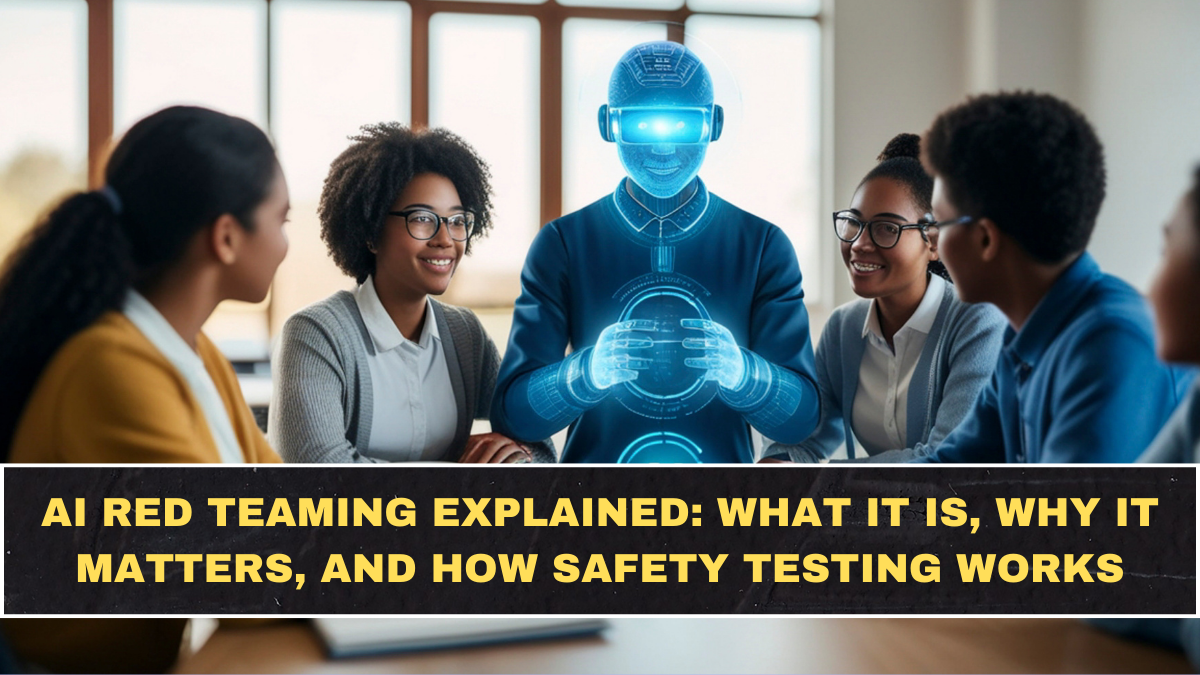
AI systems in 2026 are powerful enough to cause real damage when they fail silently. From hallucinated legal advice to unsafe automation, most serious AI incidents do not happen because models are malicious, but because teams never tested how systems break under pressure. This is where AI red teaming enters the picture.
AI red teaming is not about hacking for fun or proving how smart testers are. It is a structured process to deliberately stress AI systems, expose failure modes, and reduce risk before users encounter them. In 2026, red teaming has become a standard safety practice for serious AI deployments, not an optional experiment.
What AI Red Teaming Actually Means
AI red teaming is the practice of intentionally trying to make an AI system fail in controlled ways. The goal is to uncover weaknesses, unsafe behavior, or unintended outputs before they reach real users.
Unlike traditional testing, red teaming focuses on adversarial scenarios. Testers behave like curious, careless, or malicious users to see how the system responds under stress.
In 2026, red teaming is viewed as proactive safety engineering rather than reactive damage control.
Why Normal Testing Is Not Enough for AI Systems
Standard testing checks whether a system works as expected. Red teaming checks how it behaves when expectations are violated.
AI models are probabilistic and context-sensitive. They can behave well in routine cases and fail spectacularly in edge cases. These failures are often unpredictable without adversarial testing.
Red teaming fills the gap between “it usually works” and “it is safe to deploy.”
Common Failure Patterns Red Teams Look For
Red teams focus on predictable categories of failure. These include hallucinations in high-stakes contexts, instruction bypass through prompt manipulation, and unsafe content generation.
They also test for overconfidence, where models provide definitive answers despite uncertainty. Another common issue is policy drift, where behavior changes subtly over time.
In 2026, understanding these patterns helps teams prioritize fixes instead of chasing random bugs.
What Is Allowed in AI Red Teaming
Red teaming is conducted within defined boundaries. Teams agree in advance on what systems can be tested, what data can be used, and what actions are off-limits.
The goal is not to exploit systems in the wild but to learn in a controlled environment. Ethical guidelines and legal constraints are respected throughout the process.
Clear scope prevents chaos and ensures findings are actionable.
How Companies Structure Red Team Exercises
Most teams structure red teaming as time-boxed exercises with clear objectives. They define target behaviors, testing methods, and success criteria upfront.
Findings are documented, categorized by severity, and mapped to mitigation steps. This turns red teaming into a learning process rather than a blame exercise.
In 2026, mature teams treat red team outputs as inputs for system improvement, not performance evaluation.
The Role of Jailbreak Testing
Jailbreak testing is a subset of red teaming focused on bypassing safeguards. Testers try to trick models into producing restricted or unsafe outputs.
This helps teams understand how robust safety mechanisms are under adversarial input. It also reveals where policies are unclear or inconsistent.
Jailbreak testing is not about defeating safety forever; it is about identifying weaknesses to strengthen defenses.
Why Red Teaming Is a Governance Requirement
As AI systems influence more decisions, organizations are expected to demonstrate due diligence. Red teaming provides evidence that risks were considered and addressed.
Regulators and stakeholders increasingly ask how systems were tested for misuse. Red teaming documentation answers this question directly.
In 2026, red teaming is as much about accountability as it is about safety.
Who Should Be Involved in Red Teaming
Effective red teams are cross-functional. They include engineers, domain experts, and sometimes external reviewers who bring fresh perspectives.
Diversity of thinking matters because AI failures often occur outside expected use cases. A narrow team misses blind spots.
Including non-technical voices improves realism and coverage.
Common Mistakes Teams Make With Red Teaming
One common mistake is treating red teaming as a one-time exercise. AI systems evolve, and so do their risks.
Another mistake is focusing only on spectacular failures while ignoring subtle degradation. Small issues can compound over time.
In 2026, red teaming must be continuous and proportionate to system impact.
How Red Team Findings Improve AI Systems
Findings from red teaming inform prompt design, filtering, monitoring, and user interface decisions. They also influence governance policies and escalation paths.
By exposing weaknesses early, teams reduce incident severity and response time. This builds confidence in AI deployments.
Red teaming turns unknown risks into managed ones.
Conclusion: Red Teaming Makes AI Safer by Design
AI red teaming is not about proving systems are dangerous. It is about making them dependable. By intentionally exploring failure, teams learn where safeguards hold and where they crack.
In 2026, red teaming is a sign of maturity, not mistrust. Organizations that invest in it ship safer systems and respond better when issues arise.
Testing for failure is not pessimism. It is responsibility.
FAQs
What is AI red teaming?
It is a structured process of adversarial testing to identify safety and reliability risks in AI systems.
Is red teaming the same as hacking?
No, it is conducted ethically within defined boundaries to improve system safety.
When should teams perform red teaming?
Before deployment and periodically after major changes or expansions in use.
Do small teams need red teaming?
Yes, even lightweight red teaming helps uncover blind spots early.
What is jailbreak testing?
It is testing aimed at bypassing AI safeguards to identify weaknesses in safety controls.
Does red teaming guarantee safety?
No, but it significantly reduces unknown risks and improves preparedness.