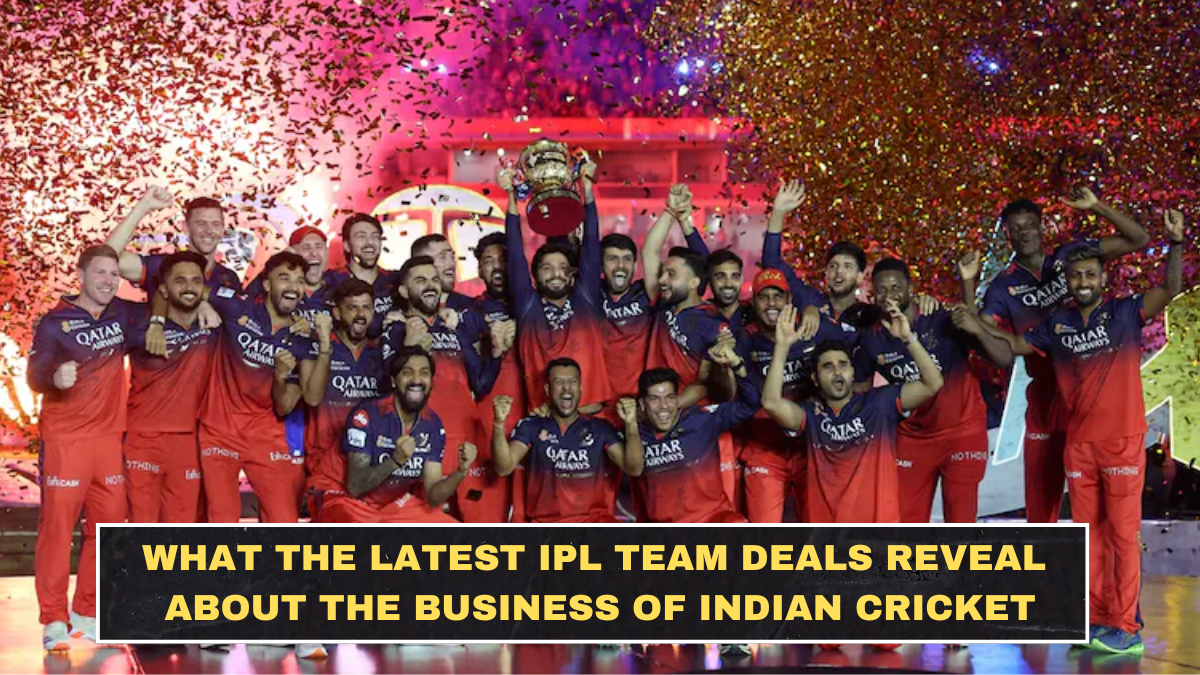
The latest IPL team deals are not just expensive transactions. They are a message. Investors are no longer treating IPL franchises like flashy cricket trophies for rich owners. They are treating them like premium media assets with pricing power, sponsor depth, and long-term growth potential.
That shift became impossible to ignore in March 2026. Reuters reported that Royal Challengers Bengaluru was sold to a consortium led by Aditya Birla Group, Times Group, Bolt Ventures, and Blackstone at a valuation of $1.78 billion. Around the same time, Rajasthan Royals was reported sold at about $1.63 billion. Those are not normal sports-team numbers for a domestic cricket league.
Why These Deals Matter Beyond the Headlines
A lot of people see billion-dollar valuations and stop there. That is lazy analysis. The important question is not whether the numbers are big. The important question is what exactly makes investors willing to pay them.
The answer starts with the IPL business model. BCCI’s official announcement on the 2023–2027 media rights cycle put the total value at ₹48,390.32 crore. That enormous rights pool gives franchises a powerful financial base before they even start counting sponsorship, ticketing, hospitality, licensing, and merchandise.
So these deals reveal something simple: IPL teams are no longer valued mainly on match performance. They are valued on access to one of the richest sports-media systems in the world.
The Real Engine Behind IPL Valuations
The biggest driver is central revenue. Recent industry reporting says an IPL franchise can receive roughly ₹500 crore from central revenue, largely due to media rights, with additional income coming from sponsorships, ticketing, and merchandise. That is why annual franchise revenue is often estimated around ₹700–800 crore.
That matters because it creates a more predictable business base than many people assume. A buyer is not just betting on winning matches. A buyer is buying into:
- a revenue-sharing system
- an established attention machine
- brand partnerships at team level
- scarcity, since there are only a limited number of IPL teams
This is exactly why valuations have detached from simple sporting logic. Investors are paying for future relevance, not just current profit.
What the RCB and Rajasthan Royals Deals Really Say
RCB’s valuation says brand strength matters almost as much as revenue. Reuters noted that RCB generated $56 million in revenue in 2024–25, up 73% over three years, and had the extra advantage of being one of the original IPL teams with massive fan recognition and a title win in 2025.
Rajasthan Royals tells a slightly different story. The Royals do not have RCB’s mass-market popularity, but their sale at around $1.63 billion still shows investors are pricing the league itself very aggressively. In plain terms, even a less commercially loud IPL brand can now cross the billion-dollar mark.
That reveals a broader truth about Indian cricket: the league brand is carrying huge value on its own.
| Deal or metric | Latest signal | What it reveals |
|---|---|---|
| RCB valuation | $1.78 billion | Premium IPL brands now command global-style sports valuations. |
| Rajasthan Royals valuation | $1.63 billion | Even teams with lower mass-market noise are crossing the billion-dollar mark. |
| IPL media rights | ₹48,390.32 crore for 2023–2027 | Broadcast money is the core valuation engine. |
| Estimated annual team revenue | Around ₹700–800 crore | Teams have real cash flow, but valuations still imply rich multiples. |
Are These Valuations Actually Rational?
This is where the story gets uncomfortable. Not everyone thinks these numbers are fully justified. Business Standard reported that if a team earns roughly ₹700–800 crore annually, then a valuation of $1.6–1.8 billion implies revenue multiples of about 20x to 22x, which some analysts consider a major premium to intrinsic value.
That does not mean the deals are irrational. It means buyers are not valuing teams like ordinary businesses. They are valuing them like scarce strategic properties with long-term upside in media, sponsorship, global cricket expansion, and possibly future monetisation routes.
So the honest reading is this:
- current earnings alone do not fully explain the prices
- scarcity and future expectations are doing a lot of the work
- buyers believe IPL’s commercial ceiling is still rising
Anyone pretending these are purely fundamentals-driven deals is fooling themselves.
What This Says About the Business of Indian Cricket
These valuations show that Indian cricket’s centre of gravity is no longer just the national team or bilateral tours. The real commercial power sits in franchise cricket, and IPL is the crown jewel.
Economic Times reported that the fresh RCB deal triggered a surge in the perceived value of other IPL franchises, reinforcing the idea that the league has become the world’s richest cricket enterprise. Business Standard also noted that franchise brand valuations have risen dramatically since the early years of the league.
That tells you something bigger than sport. Indian cricket has built a model where:
- media rights create scale
- franchise scarcity creates investor urgency
- fan loyalty creates brand resilience
- sponsorship monetises attention at every layer
This is why IPL ownership is now drawing global capital, not just domestic business houses.
What Could Happen Next
The latest deals may raise expectations for all remaining franchises. More teams could explore stake sales, partial monetisation, or strategic partnerships if investor appetite remains strong. Once one or two benchmark deals reset market expectations, everyone starts repricing the league.
But there is also risk. If valuations run too far ahead of cash flow, future buyers may get more cautious. A hot market can keep climbing for a while, but not forever. The stronger the headline numbers get, the more people will start questioning whether IPL teams are being valued as businesses or as scarcity-driven prestige assets.
Conclusion
The latest IPL team deals reveal that Indian cricket has become a far more sophisticated business than many fans still admit. RCB at $1.78 billion and Rajasthan Royals at $1.63 billion show that investors now see IPL teams as premium media and sports properties, not just cricket clubs.
The blunt truth is this: these deals are not just about cricket success. They are about media rights, central revenue, scarcity, brand equity, and belief in future growth. That is what the business of Indian cricket looks like now. The game is still on the field, but the real power is increasingly in the balance sheet.
FAQs
Why are IPL teams worth so much in 2026?
Because investors are valuing them as scarce, high-visibility sports-media assets backed by major broadcast revenue, sponsor interest, and long-term growth expectations.
What are the latest IPL team valuation numbers?
Recent reporting put RCB at $1.78 billion and Rajasthan Royals at about $1.63 billion.
Are these valuations based only on current earnings?
No. Reporting suggests current revenue supports part of the value, but scarcity, brand power, and future expectations are also pushing valuations much higher.
What do these deals reveal about Indian cricket?
They show that franchise cricket, especially IPL, has become one of the strongest commercial engines in Indian sport, driven by broadcast money, sponsorship, and investor demand.