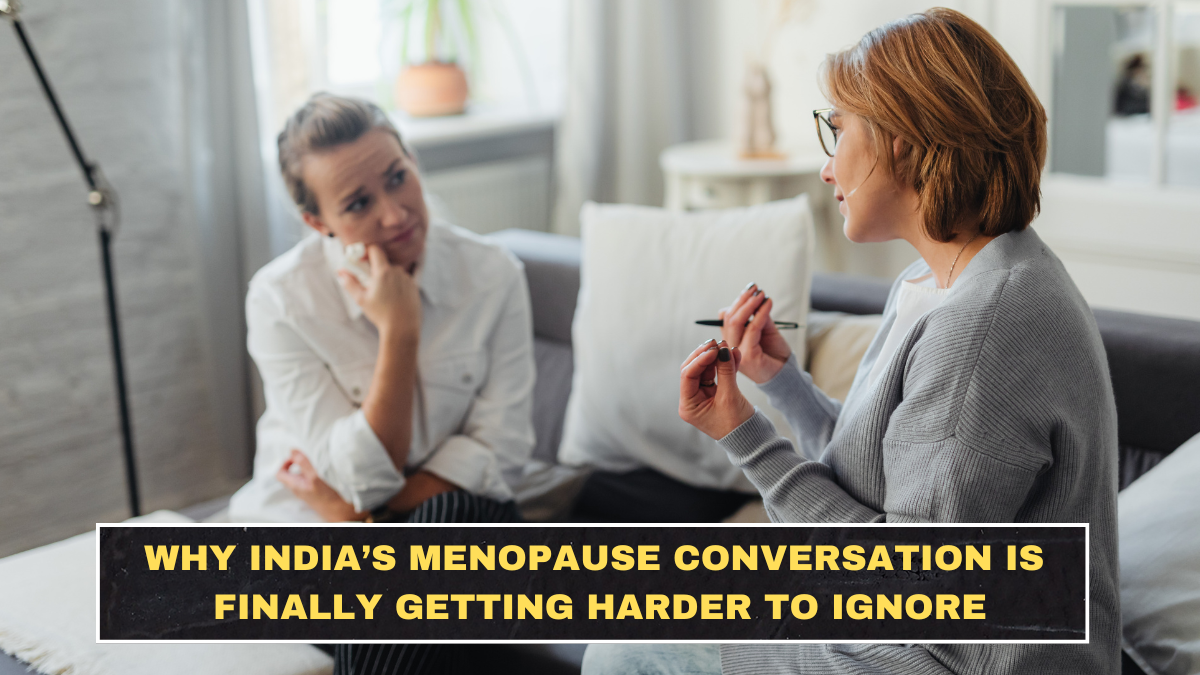
For years, menopause in India was treated like a private inconvenience rather than a real health phase. Women were expected to manage hot flashes, sleep issues, mood shifts, body changes, and brain fog quietly, while everyone around them pretended nothing important was happening. That silence is getting harder to maintain now, not because India suddenly became enlightened, but because too many women are pushing back against being ignored.
The change is becoming visible in media, health policy discussions, and workplaces. Recent reporting in The Indian Express described this as India’s “menopause moment,” with doctors and advocates arguing that women in their 40s are still being underserved by both public conversation and clinical support. The same report said many Indian women may experience menopause earlier than the usual Western narrative suggests, sometimes between 38 and 45, which makes the gap in awareness even more serious.

Why the Topic Is Suddenly More Visible
The first reason is demographic reality. The number of Indian women in or approaching menopausal age is huge, so pretending this is a niche issue was always dishonest. A 2025 global health article noted that the number of Indian women at menopausal age is rising sharply and cited estimates that women aged 45 or older could reach 401 million by 2026. Even if exact projections vary by source, the broad point is obvious: this is a mass-life-stage issue, not a boutique wellness trend.
The second reason is that the symptoms affect work, relationships, sleep, mental health, and daily functioning in ways that are harder to dismiss once women start naming them publicly. A new 2026 study in Frontiers in Global Women’s Health found that menopausal symptoms impair work ability and quality of life among Indian working women, especially in physically demanding and lower-resource settings. That matters because it moves the issue from “personal discomfort” into “public health and labour reality.”
The Workplace Is a Big Reason This Conversation Is Growing
A major reason the discussion is becoming louder is work. Women are staying in the workforce longer, and midlife health cannot be separated from employment anymore. A 2026 policy brief on menstrual and menopausal health at work in India argues that workforce participation, economic security, and women’s health are directly linked, and that workplaces still do a poor job of recognising these realities.
That point matters because menopause does not happen in isolation. It happens while women are managing jobs, caregiving, family expectations, and often leadership responsibilities too. When workplaces have no language, flexibility, or support around menopause, the burden does not disappear. It just becomes invisible labour carried by women alone. The policy brief makes clear that the issue is not only medical. It is also about dignity, participation, and whether women can stay productive without being forced to suffer in silence.
Here is where the conversation is shifting fastest:
- workplace wellbeing and retention
- women’s health after 45
- earlier recognition of symptoms
- demand for India-specific guidance
- less stigma around discussing midlife health
India-Specific Reality Matters
One reason older menopause discussions felt irrelevant is that they leaned too heavily on Western assumptions. The recent Indian Express report said 90% of menopause-related information is based on Western women, while Indian women often face different timing, social pressures, and healthcare access issues. That is a serious problem, because health information becomes less useful when women cannot see their own lives reflected in it.
India-specific clinical guidance is beginning to catch up. The 2026 executive summary of the Indian Menopause Society’s clinical practice guidelines shows that the field is becoming more formalised and better structured within Indian medicine. That does not solve the awareness gap overnight, but it does show the conversation is moving from vague advice toward more grounded clinical support.
What Women Are Actually Dealing With
This topic gets trivialised because people reduce it to hot flashes. That is nonsense. WHO’s menopause fact sheet makes clear that menopause can involve a wide range of symptoms, including sleep disturbance, mood changes, joint pain, vaginal symptoms, and effects on wellbeing. The new Indian workplace study adds work-ability and quality-of-life impacts to that picture.
That means the issue is bigger than comfort. It affects concentration, confidence, physical ease, and how women move through daily life. This is exactly why the conversation is becoming harder to ignore: once the symptom burden is named honestly, the old habit of dismissing it as “just aging” starts to look irresponsible.
| What is changing | What recent evidence suggests | Why it matters |
|---|---|---|
| Public conversation | Indian media is covering menopause more directly in 2026 | The silence is weakening. |
| Workplace attention | A 2026 India policy brief connects menopause to labour participation and wellbeing | Workplaces can no longer treat it as irrelevant. |
| Clinical understanding | Indian clinical menopause guidelines were published in 2026 | More formal, India-specific medical framing is emerging. |
| Research evidence | A 2026 study found work ability and quality of life are affected among Indian working women | Symptoms have measurable practical impact. |
| Population scale | India has a very large and growing population of midlife women | This is a mainstream issue, not a niche one. |
Why the Conversation Still Has Gaps
Do not over-romanticise this shift. India is not suddenly menopause-literate. Awareness may be improving, but stigma, weak workplace policy, patchy healthcare conversations, and lack of routine screening or support are still real problems. The current moment is better described as an opening, not a solution.
There is also a class divide people avoid mentioning. Urban professionals are more likely to encounter the new language of menopause support, while women in lower-income, physically demanding, or rural settings may still get much less recognition and fewer options. The 2026 Indian workplace study specifically highlighted that low-resource jobs carry distinct burdens, which should kill the lazy assumption that one polished corporate policy solves the whole issue.
What This Means Now
The real shift is not that menopause became fashionable. It is that more women, employers, clinicians, and writers are finally being forced to admit that midlife women’s health was under-discussed for too long. That matters because silence usually protects systems, not people. Once the issue becomes speakable, better guidance, workplace flexibility, and earlier care become more realistic.
The hard truth is this: India’s menopause conversation is getting louder because women made it louder. Institutions are only starting to respond after years of avoidance. That is progress, but it is also an indictment of how little attention women’s health after 45 received until the pressure became impossible to ignore.
Conclusion
India’s menopause conversation is finally getting harder to ignore because the scale, the symptoms, and the workplace impact are too big to keep hiding. Recent reporting, policy work, research, and clinical guidance all point in the same direction: menopause is not a minor private issue. It is a major women’s-health and midlife-workforce issue that deserves much more serious attention.
The blunt reality is that India is still late to this conversation. But late is better than silent. The next step is not more token awareness posts. It is better healthcare conversations, better workplace support, and less social stupidity around what women experience after 45.
FAQs
Why is menopause becoming a bigger conversation in India now?
Because more women are speaking openly about symptoms, workplaces are being forced to confront midlife health issues, and new research and reporting are making the scale of the problem harder to ignore.
At what age does menopause usually happen?
WHO says natural menopause usually occurs between ages 45 and 55 worldwide, but recent Indian reporting says many Indian women may experience it earlier than common Western expectations suggest.
Why does menopause matter at work?
Because symptoms can affect sleep, concentration, confidence, physical comfort, and work ability. A 2026 Indian study and policy brief both argue that the workplace impact is real and under-recognised.
Is India getting better menopause guidance now?
Yes, slowly. India now has updated clinical guidance through the Indian Menopause Society, and recent public discussion shows more recognition of the need for India-specific support.