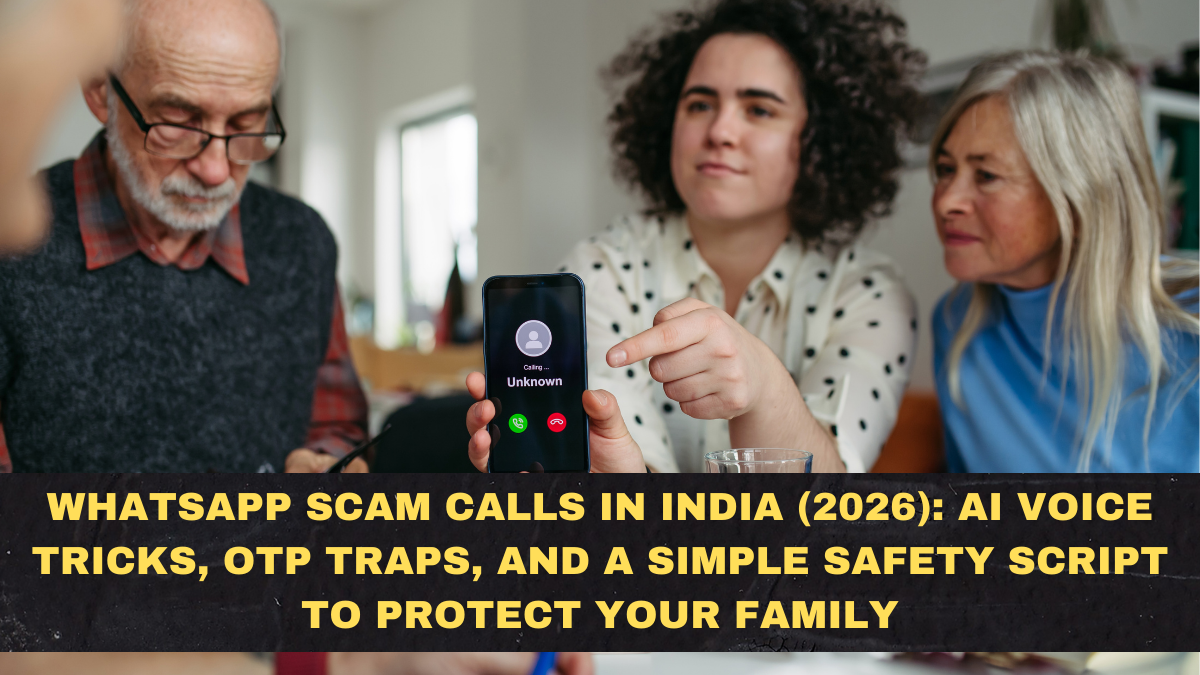
WhatsApp scam calls in India have crossed into a new and far more dangerous phase in 2026. These are no longer crude calls from unknown numbers with broken Hindi or robotic threats about blocked bank accounts. They now sound polite, local, confident, and disturbingly real, often using AI-cloned voices that mimic banks, police officers, or even family members.
What makes these scams terrifying is not just the money loss. It is the psychological manipulation layered into them. Callers now use urgency, authority, emotional pressure, and fake verification steps to override rational thinking. Even digitally literate adults are getting trapped, not because they are careless, but because these scams are engineered to exploit normal human reactions.
This guide explains how WhatsApp scam calls in India 2026 actually work, the new AI voice tricks being used, the most common OTP traps, and a simple safety script every family should follow when a suspicious call comes in.
Why WhatsApp Scam Calls Feel More Real in 2026
The biggest change in scam calls is realism.
Scammers now use AI voice cloning trained on leaked audio, social media videos, or previous phone calls. This allows them to sound like customer care agents, police officials, or even relatives. In some cases, victims hear a voice that sounds exactly like their son, daughter, or spouse asking for urgent financial help.
The emotional shock created by hearing a familiar voice bypasses logic. That moment of panic is when people follow instructions they normally never would.
The New Scam Flow Most Indians Are Falling For
Most WhatsApp scam calls now follow a predictable psychological structure.
The caller introduces themselves as a bank officer, courier executive, telecom authority, or police official. They claim there is an urgent problem such as a blocked account, illegal transaction, undelivered parcel, or suspicious SIM activity.
Then comes the pressure phase. Victims are told their account will be frozen, their number disconnected, or legal action initiated unless immediate verification is completed. Finally, the trap is sprung through OTP requests, UPI collect approvals, or fake refund links.
The scam succeeds not because people are stupid, but because the script is engineered for panic compliance.
AI Voice Scams: The Most Dangerous New Variant
AI voice scams are now the fastest-growing category in India.
Scammers clone voices from social media reels, WhatsApp voice notes, or YouTube videos. They then call family members claiming to be in an accident, arrested, or in trouble, asking for urgent money.
These calls are short, emotional, and deliberately chaotic. Victims are pushed to act before verifying anything. By the time the truth is discovered, the money is already gone.
This technique works frighteningly well on elderly parents and emotionally sensitive individuals.
The OTP Trap Explained Simply
The OTP trap is still the core weapon.
Scammers trigger a real OTP by attempting login or payment on a genuine platform. They then call the victim pretending to be customer care and ask for the OTP “for verification” or “to cancel a fraudulent transaction.”
The moment the OTP is shared, the attacker completes the transaction or account takeover.
No legitimate bank, wallet, or government office will ever ask for your OTP. Ever.
UPI Collect and Refund Scams Are Still Working
UPI scams remain brutally effective.
Victims are told they are receiving a refund or prize money. They are asked to approve a UPI collect request to “credit” the amount. In reality, approving the request debits money from their account.
Some scammers combine this with screen-sharing requests or fake refund screenshots to increase credibility.
This scam still works because people misunderstand how UPI requests function.
WhatsApp Impersonation and Fake Verification Links
Another growing scam involves WhatsApp messages pretending to be official alerts.
Victims receive messages claiming their account, courier, or payment is stuck. They are given a fake verification link that looks legitimate. Once clicked, it steals login credentials or installs spyware.
These links often come from hijacked WhatsApp accounts of known contacts, which increases trust.
This makes verification habits critical.
Why Even Smart People Fall for These Scams
This is the uncomfortable truth.
These scams work because they attack human psychology, not technical ignorance.
They create urgency.
They use authority.
They simulate legitimacy.
They exploit fear and emotion.
Under stress, even cautious people follow instructions they would normally reject.
This is not stupidity. It is cognitive overload.
The One Rule That Instantly Breaks Most Scams
This rule is absolute.
Never act on a call or message that creates urgency involving money, OTPs, or account threats.
Pause.
Hang up.
Verify independently using official numbers or known contacts.
Scammers rely entirely on preventing this pause.
A Simple Safety Script Every Family Should Use
This script stops 90 percent of scams.
“I do not complete financial actions on calls or messages. I will verify and call back using an official number.”
Say it out loud. Then hang up.
If the call is real, nothing bad will happen.
If it is a scam, you just saved your money.
What Families Should Do Proactively
Families need shared safety rules.
Never share OTPs.
Never approve UPI requests from unknown senders.
Never click financial links sent on WhatsApp.
Never trust caller ID alone.
Always verify emergencies with a second call.
These habits reduce scam success rates dramatically.
Why This Problem Will Keep Growing
Scams will not decrease in 2027.
AI tools are making voice cloning cheaper and easier. Data leaks provide endless training material. Law enforcement response remains slow and fragmented.
Scammers are professionalizing faster than regulators can react.
Individual-level defense is now the only reliable shield.
Conclusion: Awareness Is Your Real Firewall
WhatsApp scam calls in India 2026 are not a passing trend.
They are a permanent feature of the digital economy.
No app, government rule, or telecom filter will fully protect you.
Only behavioral habits will.
If you pause, verify, refuse OTP sharing, and follow the safety script, you neutralize almost every scam variant currently operating.
This is no longer about tech knowledge.
It is about survival habits in a hostile digital environment.
FAQs
What is the most common WhatsApp scam call in India right now?
Fake bank or courier calls asking for OTPs or UPI approvals.
Are AI voice scams really happening in India?
Yes. Multiple real cases involve cloned voices of relatives or officials.
Can banks ever ask for OTPs on calls?
No. No legitimate organization will ever ask for your OTP.
What should I do if I receive a scary urgent call?
Hang up, pause, and verify independently.
Is caller ID or Truecaller reliable for safety?
No. Scammers spoof numbers and names easily.
What is the safest response to any financial call?
Refuse action, verify offline, and call back using official numbers.