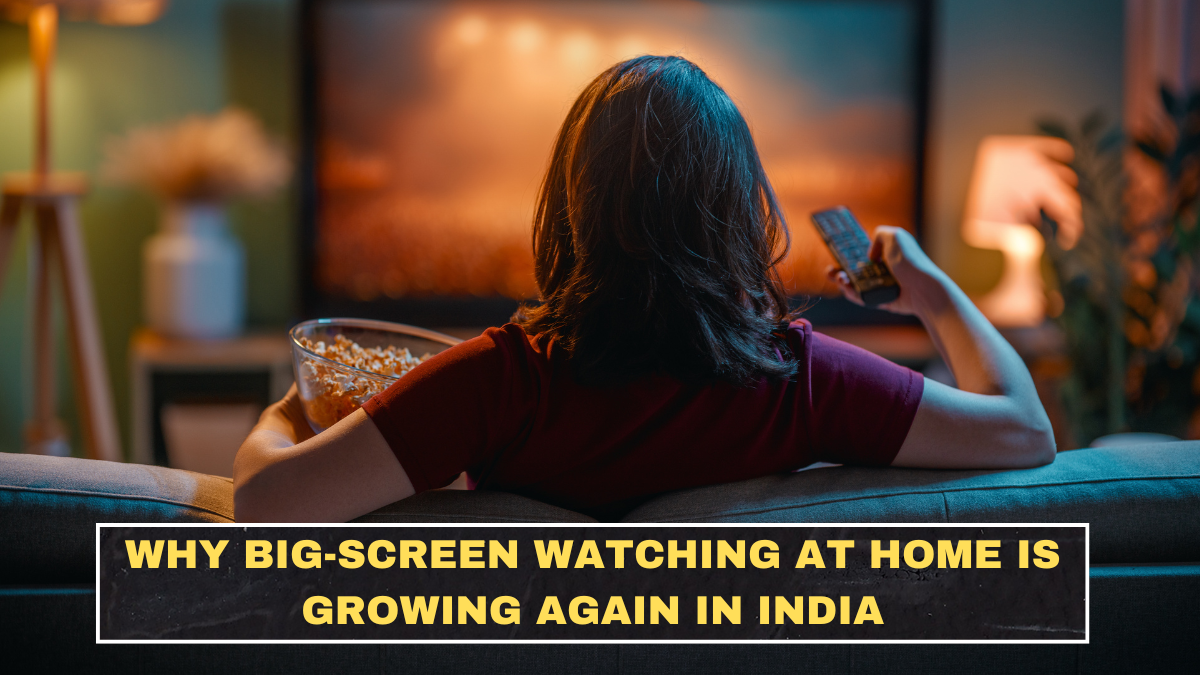
A lot of people assume big-screen watching at home is growing only because IPL season creates temporary excitement. That is too simplistic. The current data points to a broader shift in Indian home entertainment. Counterpoint Research said India’s smart TV shipments were largely flat in 2025 overall, but larger screens and QLED continued to gain share, with the ₹40,000–₹50,000 price band outperforming the broader market as consumers moved toward better-equipped televisions. That means the market is not simply about buying more TVs. It is about buying better screens when people do upgrade.
The viewing side also supports this. Ormax Media said India’s connected TV audience grew 85% in one year, rising from 69.7 million in 2024 to 129.2 million in 2025, and that connected TV became the number-two device for streaming in India after smartphones. That is a big shift in behavior. It suggests more Indian households are becoming comfortable using the living-room screen for digital viewing, not just for traditional TV channels.
Sports and Streaming Are Pulling the Living Room Back
Cricket is one of the biggest reasons this is happening. JioStar said IPL 2025 reached 1.19 billion viewers across TV and digital, with digital alone reaching 652 million and television 537 million. That matters because the real story is not “digital beat TV.” The real story is that sports viewing is now spread across multiple screens, and the home screen still matters a lot when the event feels collective, premium, or social. Big matches pull people back into shared viewing.
There is also a connected-TV layer inside this trend. JioStar said CTV viewership for IPL 2025 grew 49%, while Nielsen and JioStar’s later cross-screen measurement study found that CTV, linear TV, and mobile each added meaningful incremental reach, with less than 5% audience overlap across LTV, CTV, and mobile in the study. That means large-screen viewing is not replacing mobile. It is becoming one of several viewing modes people use depending on context. For live sports, family watching, and premium streaming, the larger screen is clearly becoming more relevant again.
Bigger Screens Are Growing Even When the Overall TV Market Is Flat
This is where the trend becomes more interesting. A flat TV market usually suggests weak demand. But Counterpoint’s March 2026 update says the Indian smart TV market stayed largely flat in 2025 while larger screens and QLED kept gaining share. That means replacement demand is shifting upward. Consumers are not necessarily buying TVs more often, but when they do buy, many are choosing a more premium viewing experience than before.
That fits a broader consumer pattern in India. Instead of spending only on basic ownership, people are increasingly spending on better experiences. In home entertainment, that means screen size, display quality, and setup convenience matter more than they did a few years ago. The growth in connected-TV viewing supports the same conclusion: the living room is becoming more digitally relevant, not less.
Projectors Are Part of the Story, but They Are Not the Whole Story
Projectors are getting more attention because they promise a cinema-like screen size at home without requiring a giant television. The broader projector market is also still growing. ResearchAndMarkets estimates the global projector market will rise from $11.63 billion in 2025 to $12.16 billion in 2026, with home entertainment listed as one of the growth drivers. That does not prove India alone is driving projector adoption, but it does support the idea that home viewing upgrades are not limited to TVs.
Still, it would be dumb to overstate the projector trend in India without direct country-level shipment data in hand. The safer conclusion is that projectors are part of the broader “bigger-screen-at-home” mindset, especially for sports, movies, and occasional group viewing, but smart TVs remain the clearer mass-market signal right now. The evidence for India is much stronger on larger-screen TVs and connected-TV usage than on projectors specifically.
Table: What the Current Data Suggests About Big-Screen Viewing in India
| Signal | Current evidence | What it suggests |
|---|---|---|
| Larger-screen TV demand | Counterpoint says larger screens and QLED gained share in 2025 | Buyers are upgrading for quality, not just replacing old sets. |
| Connected TV growth | Ormax says India’s CTV audience grew from 69.7M to 129.2M in one year | More streaming is moving to the living-room screen. |
| IPL scale | JioStar said IPL 2025 reached 1.19B viewers across TV and digital | Premium sports still drives large shared home viewing. |
| CTV sports use | JioStar said IPL 2025 CTV viewership grew 49% | Sports is helping connected-TV habits grow faster. |
| Multi-screen behavior | Nielsen/JioStar found low overlap across LTV, CTV, and mobile | People are not choosing one screen only; they switch by use case. |
| Projector interest | Global projector market is still growing, with home entertainment as a driver | Some households want a cinema-style screen, though India-specific proof is thinner. |
Why Home Viewing Feels More Valuable Again
The deeper shift is not technical. It is behavioral. Streaming used to feel like something mainly consumed alone on phones. That is still true for a lot of content. But sports, blockbuster films, and certain high-attention shows work better on larger screens, especially when people are watching together. Connected TV growth in India suggests the home screen is no longer just a legacy device. It is now part of the digital streaming habit itself.
There is also a quality expectation problem. Once viewers get used to sharper displays, larger panels, and smoother smart-TV interfaces, smaller-screen watching feels like a compromise for some types of content. That does not mean phones are losing. It means the role of the big screen is getting more defined: family viewing, sports, premium entertainment, and social watching at home.
What This Means for Buyers
For normal buyers, the takeaway is simple. The big-screen trend in India is less about showing off and more about comfort, immersion, and shared use. If most viewing in a household is still casual and solo, a premium large screen may not matter much. But if the home is increasingly used for IPL nights, OTT movies, family streaming, or connected-TV use, then bigger screens make more practical sense than they did earlier.
The more honest conclusion is that India is not seeing a blind rush to giant living-room setups. It is seeing a more selective shift toward better home viewing where the use case is strong. That is why larger screens are gaining share even in a flat shipment market. People are buying with more intent now.
Conclusion
Big-screen watching at home is growing again in India because the mix of sports, streaming, and connected-TV behavior is pulling more attention back to the living room. Counterpoint’s 2025 TV data shows larger screens and QLED gaining share, while Ormax’s numbers show a sharp rise in connected-TV viewing. Add IPL’s huge cross-screen reach and rising CTV use, and the pattern becomes clear: home entertainment in India is becoming more screen-conscious again.
The lazy take is that this is just an IPL-season blip. The better take is that Indian households are getting more comfortable using the big screen for digital entertainment, not only for old-style television. That is why this trend matters. It is not just about bigger TVs. It is about a bigger role for the home screen again.
FAQs
Is the big-screen home viewing trend actually growing in India?
Yes, the current signals point that way. Counterpoint says larger-screen TVs gained share in 2025, and Ormax says India’s connected-TV audience grew 85% year over year.
Is IPL one of the reasons for this trend?
Yes, sports is clearly part of it. JioStar said IPL 2025 reached 1.19 billion viewers across TV and digital, and CTV viewership for the season grew 49%.
Are projectors becoming popular in India too?
There is broader evidence that home entertainment is supporting projector-market growth globally, but the evidence in hand is stronger for larger-screen TVs and connected-TV viewing in India than for projectors specifically.
Does this mean mobile viewing is declining?
No. The current evidence suggests multi-screen behavior is growing. Nielsen and JioStar found low overlap across linear TV, connected TV, and mobile, which means people use different screens for different situations.