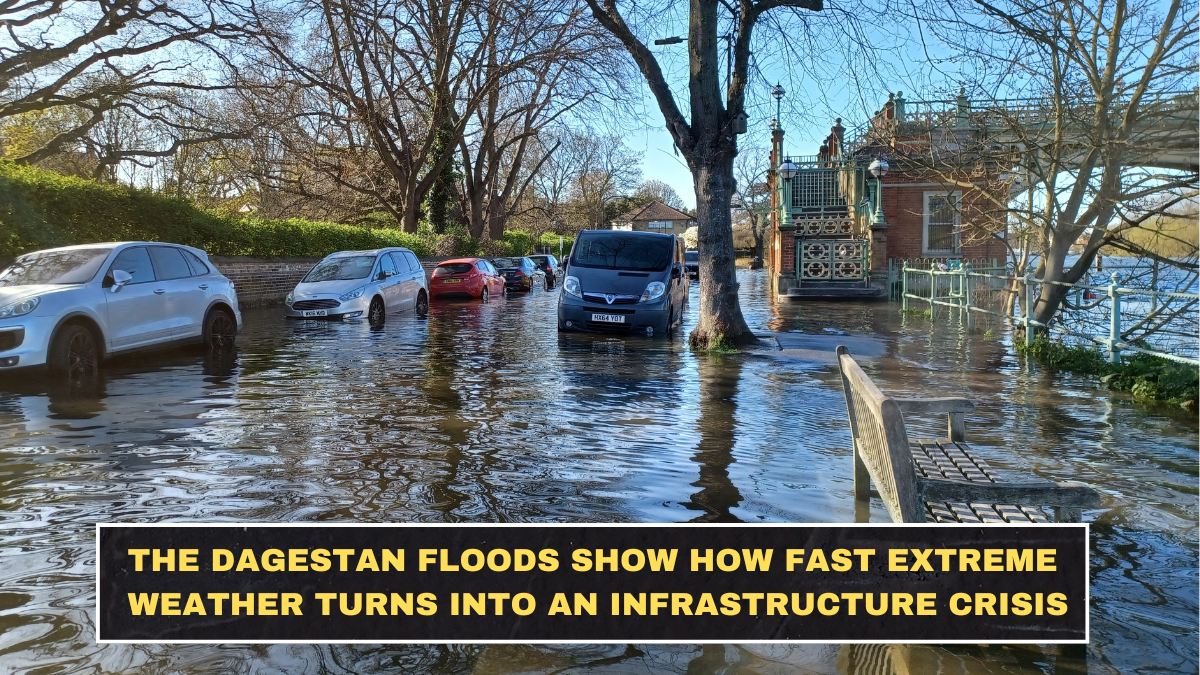
The Dagestan floods matter because they stopped being “bad weather” almost immediately and turned into a full infrastructure emergency. Reuters reported on March 28 that authorities declared a state of emergency in Makhachkala, the capital of Russia’s southern Dagestan region, after heavy rainfall caused flooding and cut electricity to more than 327,000 people across 283 settlements. That included nearly 90,000 children. Once outages hit at that scale, this is no longer just a weather story. It is a systems-failure story.
What happened
The trigger was intense rainfall that overwhelmed urban systems and surrounding infrastructure. Reuters reported that emergency services were placed on high alert, while local authorities said assistance was being organized for affected residents. Dagestan’s regional head, Sergei Melikov, said officials had prepared for worsening weather, but the scale of the disaster exceeded expectations. That detail matters, because it shows the region was not caught completely unaware. It was simply not resilient enough for the event that actually arrived.
Why the power outages are the real warning sign
Flood images get attention, but the power breakdown tells the more serious story. Reuters reported that more than 327,000 people lost electricity, which means the disruption spread far beyond a few flooded streets. When outages hit hundreds of settlements at once, the knock-on effects get ugly fast:
- water and pumping systems come under pressure
- transport and communications become less reliable
- homes, schools, and businesses lose basic services
- emergency response becomes slower and harder to coordinate
That is why the flood should be read as an infrastructure stress test, not just a rainfall event.
The bridge damage makes the situation worse
Reuters also reported that in Khasavyurt, two spans of a railway bridge on the North Caucasus Railway collapsed because of the heavy rain. That detail is easy to miss, but it is one of the most important facts in the whole story. Once transport infrastructure starts failing, recovery gets harder, supply movement slows, and economic disruption grows. Power outages are serious enough. Add damaged rail infrastructure, and you have a wider regional emergency.
What the numbers show
| Indicator | Reported figure | Why it matters |
|---|---|---|
| People without power | 327,000+ | Shows the crisis reached regional scale |
| Children affected | Nearly 90,000 | Highlights the social impact of the outage |
| Settlements affected | 283 | Confirms this was not a localized incident |
| Emergency status | Declared in Makhachkala | Signals the severity of urban disruption |
| Railway damage | Two bridge spans collapsed | Shows the crisis spread into transport infrastructure |
The table makes the point clearly: the danger was not just floodwater. The danger was what the floodwater did to the systems people depend on every day.
Why this says something bigger about vulnerability
The most important lesson is not that Dagestan had a bad week. It is that heavy rain exposed how quickly infrastructure can fail when a region is hit by a weather event stronger than expected. Reuters reported that officials had prepared for deteriorating weather, yet the outcome still included mass blackouts and damaged rail links. That suggests the problem is not only forecasting. It is resilience. If one storm can disable electricity across hundreds of settlements, then the margin for safety was already too thin. This last point is an inference based on Reuters’ reporting of the scale of disruption despite prior preparation.
Why the emergency may not end quickly
Reuters reported that forecasts expected heavy rain to continue through Sunday after the March 28 emergency declaration. That matters because recovery is much easier when water is receding and weather stabilizes. If more rain keeps falling, then repairs, drainage work, and restoration efforts become slower and riskier. In disasters like this, the first wave of damage is often only part of the problem. Continued bad weather turns response into attrition.
What readers should watch next
The useful signals are simple:
- how quickly electricity is restored across the 283 affected settlements
- whether further transport disruptions are reported
- whether emergency status expands beyond Makhachkala
- whether additional rainfall causes fresh landslides or flooding
Those are the metrics that show whether the region is stabilizing or sliding into a longer crisis. This is an inference based on the specific systems Reuters identified as disrupted.
Conclusion
The Dagestan floods show how fast extreme weather turns into an infrastructure crisis because the real damage was not just the water itself. It was the failure of electricity, transport links, and regional resilience under pressure. More than 327,000 people losing power is not a minor disruption. It is proof that when infrastructure is stretched too thin, a storm stops being a weather event and becomes a public-systems emergency.
FAQs
How many people lost power in the Dagestan floods?
Reuters reported that more than 327,000 people were left without electricity across Dagestan.
Where was the emergency declared?
A state of emergency was declared in Makhachkala, the capital of Dagestan.
How widespread was the impact?
Reuters said the flooding affected 283 settlements, showing the disruption was regional rather than local.
Was transport infrastructure damaged too?
Yes. Reuters reported that two spans of a railway bridge in Khasavyurt collapsed because of the heavy rain.