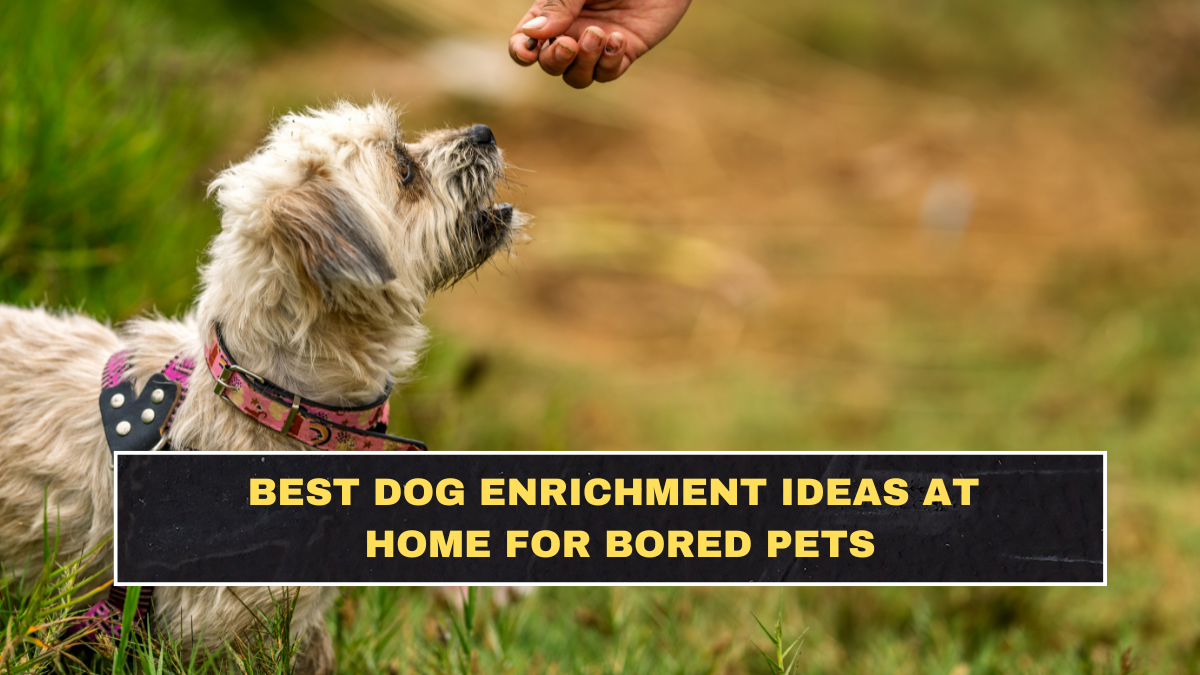
A bored dog does not usually become “bad” for no reason. More often, the dog is under-stimulated, over-rested, and left to invent its own entertainment, which is how chewing, barking, pacing, and general chaos start. AAHA says enrichment helps keep dogs mentally stimulated, burn excess energy, reduce stress and anxiety, and help prevent problem behaviors. That is the real point of home enrichment. It is not extra credit for pet owners. It is part of meeting the dog’s daily needs.

Why does home enrichment matter so much for dogs?
Because exercise alone is not the whole answer. Many owners think a walk should solve everything, then act confused when the dog still seems restless. But dogs also need opportunities to sniff, search, solve problems, chew, lick, and learn. AAHA’s 2025 indoor enrichment guidance says enrichment supports mental sharpness and stress reduction, while VCA notes that even a few minutes of trick training can act as meaningful brain enrichment. In plain language, dogs need their brains used, not just their legs.
That matters even more indoors or during busy weeks. AKC’s 2026 indoor activity guidance recommends games like hide-and-seek, indoor treasure hunts, and short obedience sessions because they give dogs a job to do inside the home. That is why the best enrichment ideas are usually simple, repeatable, and tied to natural behaviors rather than just buying another toy and hoping for the best.
Which home enrichment ideas work best for most dogs?
Food-based enrichment is one of the easiest places to start because it turns something the dog already values into an activity. AAHA highlights puzzle toys and indoor enrichment activities as boredom busters, and AKC’s 2026 DIY enrichment article gives simple examples like a muffin-tin shell game and scent-search boxes made from basic containers. These work because they force the dog to sniff, paw, and think instead of inhaling food in thirty seconds.
Scent games are another strong option because dogs naturally rely on their noses. AKC recommends hidden-treasure games and indoor search activities, and its shoebox scent game example shows how easy this can be at home. Hide treats in boxes, around one room, or under safe objects, then let the dog work for the reward. That is cheap, repeatable, and often more tiring than owners expect.
Training games also count as enrichment, which many owners forget. VCA says short daily trick-training sessions stimulate the brain, and AKC suggests obedience drills and indoor games that reinforce cues like sit, stay, and come. So yes, training is not just about manners. It is mental work, and mental work often helps settle a bored dog faster than random play does.
| Enrichment idea | Why it works | Best for |
|---|---|---|
| Food puzzle or feeder toy | Slows eating and adds problem-solving | Dogs motivated by food |
| Hide-and-seek | Builds recall and uses scent + focus | Social dogs and families |
| Treat search or scent boxes | Taps into natural sniffing behavior | Dogs that love nose work |
| Short trick training | Mental challenge with structure | Most dogs, especially indoor days |
| Toy rotation | Keeps familiar toys interesting | Dogs bored by the same setup |
| Lick or chew activity | Calming and time-filling | Dogs that need a quieter task |
Are puzzle toys and feeder games really that useful?
Yes, when used intelligently. AAHA’s enrichment guidance supports puzzle-style mental stimulation, and AKC’s DIY cognitive toy article explains how food puzzles can be adapted to a dog’s size and skill level. The point is not to frustrate the dog with something impossible. The point is to create a small challenge that rewards persistence. A beginner dog might start with easy visible food access, then move to more difficult puzzles later.
This is also where owners need to stop being lazy in a specific way. Feeding every meal from a bowl when the dog is clearly bored is usually a wasted opportunity. Not every meal needs to become a training project, but turning even one daily feeding into a search, puzzle, or slow-feeding activity can improve the dog’s day without adding much cost or time. That is a smarter use of effort than buying endless toys and leaving them scattered around.
What indoor games are easiest to do without buying much?
Hide-and-seek is one of the best because it needs almost nothing. AKC’s 2026 indoor game advice recommends asking the dog to stay, hiding elsewhere in the home, then calling the dog to find you. That builds recall, focus, and excitement at the same time. Indoor treasure hunts are similarly easy. Hide treats or kibble around a room and let the dog search. Both activities reward natural hunting and scent behaviors without needing special gear.
DIY setups also work well. AKC’s 2026 guide includes a muffin-tin puzzle and shoebox scent-search game, showing that home enrichment does not need to be expensive. The important part is safety and fit. Containers, balls, and puzzle pieces should match the dog’s size so they do not create choking risks or frustration. Cheap enrichment is good. Unsafe enrichment is stupid.
How do you keep enrichment from becoming chaotic or overwhelming?
Keep it short, supervised when needed, and matched to the dog. VCA recommends short, reward-based training sessions, and AKC’s examples scale difficulty gradually rather than jumping straight to hard puzzles. That matters because enrichment should build confidence, not confusion. A dog that quits or gets frantic is not being “challenged well.” It is being set up badly.
Rotation also helps. PetMD notes that rotating toys can keep them novel and interesting instead of leaving everything out all the time. That is a useful reminder that enrichment is not just about more stuff. It is about better use of what the dog already has. Three toys used strategically often beat fifteen toys dumped in a basket.
Conclusion
The best dog enrichment ideas at home are the ones that give the dog something meaningful to do: search, sniff, solve, chew, lick, or learn. Veterinary and behavior guidance supports enrichment because it can reduce boredom, burn mental energy, lower stress, and help prevent unwanted behaviors. Food puzzles, scent games, hide-and-seek, short training sessions, and toy rotation all work because they use the dog’s brain instead of just trying to tire out the body. If your dog seems bored at home, the answer is usually not more noise or more stuff. It is better structure and better stimulation.
FAQs
What is the easiest dog enrichment activity to start with?
A food puzzle or simple treat-search game is usually the easiest starting point because it uses food motivation and does not require much training history. AAHA and AKC both support these kinds of enrichment activities.
Can training count as enrichment?
Yes. VCA says short trick-training sessions are a form of brain enrichment, and AKC also recommends obedience and indoor training games for mental stimulation.
Are indoor enrichment games enough for dogs?
They help a lot, but they are not always a full replacement for appropriate exercise and outdoor activity. AAHA frames enrichment as part of a broader stimulation and stress-reduction approach, not as the only need a dog has.
How often should dogs get enrichment at home?
There is no one-size-fits-all number, but regular daily enrichment is supported by veterinary and behavior guidance because dogs benefit from ongoing mental stimulation, not just occasional boredom fixes.