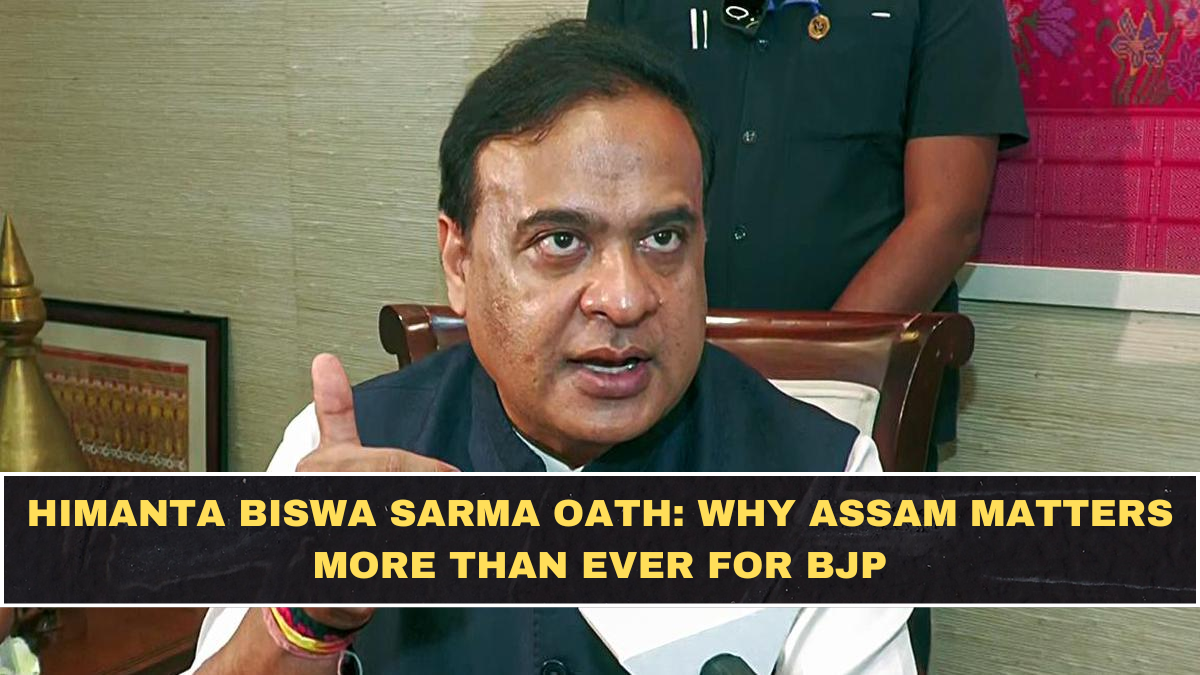
Himanta Biswa Sarma took oath as Assam Chief Minister for a second consecutive term on May 12, 2026, marking a major political moment for the BJP in the Northeast. The ceremony in Guwahati was attended by top national leaders, including Prime Minister Narendra Modi, Union Home Minister Amit Shah and Defence Minister Rajnath Singh, underlining how important Assam has become in BJP’s national map.
This oath ceremony is not just about one state government taking office again. It signals the BJP-led NDA’s continuing hold over Assam and the rise of Himanta as one of the party’s strongest regional power centres. He also becomes the first non-Congress leader in Assam to return as Chief Minister for a second straight term, which makes the moment politically bigger than a routine swearing-in.
Who Took Oath With Himanta?
| Leader | Party | Role In New Setup |
|---|---|---|
| Himanta Biswa Sarma | BJP | Chief Minister |
| Ajanta Neog | BJP | Minister |
| Rameshwar Teli | BJP | Minister |
| Atul Bora | AGP | Minister |
| Charan Boro | BPF | Minister |
Along with Himanta Biswa Sarma, four ministers were sworn in as part of the first cabinet formation. Times of India reported that Ajanta Neog and Rameshwar Teli represented the BJP, while Atul Bora came from Asom Gana Parishad and Charan Boro from Bodoland People’s Front. This early cabinet shape shows that the BJP is keeping its regional allies visible inside the government.
Why Is Assam So Important For BJP?
Assam is not just another state for the BJP. It is the party’s strongest gateway into Northeast politics, and keeping power here gives the BJP a base from which it can influence regional alliances, border-state policy, identity debates and development narratives across the region. A strong Assam government helps the party project stability in a part of India where coalition politics and local identities matter deeply.
The BJP-led NDA’s return also gives the party a psychological advantage. New Indian Express reported that the NDA stormed to a third straight term in Assam with 102 seats, while the BJP crossed the majority mark on its own for the first time in the state. That kind of mandate gives Himanta far more room to govern aggressively than a fragile coalition would.
What Makes Himanta So Powerful?
Himanta Biswa Sarma has built his image around sharp political messaging, welfare delivery, aggressive identity politics and tight organisational control. He is not just a Chief Minister who depends on the central leadership’s image; he has become a vote-puller and strategist in his own right. That is why his second term matters for BJP’s broader regional ambitions.
His political strength comes from several factors:
- Strong grassroots control across Assam’s political network.
- Ability to combine welfare politics with identity-based messaging.
- Aggressive communication style that keeps him constantly visible.
- Strong alliance management with regional partners like AGP and BPF.
- Projection as BJP’s most important Northeast face.
- Administrative image built around fast decisions and direct messaging.
What Will Be His Biggest Challenge?
The biggest challenge for Himanta’s second term is that a bigger mandate creates bigger expectations. Winning again gives him political strength, but it also removes excuses. Voters will expect visible progress on employment, flood management, infrastructure, welfare schemes, land issues, law and order, and regional identity concerns.
There is also a sharper national spotlight on Assam now. His government’s policies on land, migration, welfare and identity will be watched closely by both supporters and critics. Times of India reported that before taking oath, Himanta promised a stronger land reclamation push and welfare focus, including a major eviction-drive target. That signals a more assertive second term, but also one that may trigger political and social controversy.
Why Does This Help BJP In Northeast?
BJP’s Northeast strategy depends heavily on local leadership, alliance flexibility and state-specific messaging. Assam is the anchor of that strategy because it is the region’s largest and most politically influential state. When BJP is strong in Assam, it gains organisational confidence across neighbouring states too.
Himanta also plays a wider role through regional political coordination. His ability to work with local parties, manage ethnic equations and speak the language of regional aspiration gives BJP an advantage that cannot be built only from Delhi. That is why his oath ceremony looked like a state event but carried national importance.
What Should Opposition Watch Now?
The opposition’s problem in Assam is not just losing an election; it is losing political space. When one leader dominates both government messaging and party organisation, opponents must do more than attack him personally. They need a clear alternative on jobs, identity, welfare, migration, flood control and governance.
The opposition should watch these pressure points:
- Whether BJP can maintain internal discipline after a big win.
- Whether allies feel respected in the new government.
- Whether land and identity politics trigger backlash.
- Whether welfare schemes actually reach beneficiaries.
- Whether Congress can rebuild beyond emotional criticism.
- Whether youth unemployment becomes a serious anti-incumbency issue.
Conclusion?
Himanta Biswa Sarma’s oath as Assam Chief Minister for a second consecutive term is a major victory moment for the BJP. It confirms Assam’s place as the party’s Northeast power base and strengthens Himanta’s position as one of BJP’s most important regional leaders. The presence of top national leaders at the ceremony made the message clear: Assam is central to BJP’s political map.
But the real test starts after the ceremony. Himanta now has a strong mandate, visible national backing and high public expectations. If he delivers on welfare, infrastructure and stability, Assam can become BJP’s model state in the Northeast. If governance gets trapped in only polarising politics, the same mandate can become a burden.
FAQs?
When Did Himanta Biswa Sarma Take Oath As Assam CM?
Himanta Biswa Sarma took oath as Assam Chief Minister for a second consecutive term on May 12, 2026. The ceremony was held in Guwahati and attended by top BJP and NDA leaders.
Who Took Oath With Himanta Biswa Sarma?
Four ministers took oath along with Himanta Biswa Sarma. They included Ajanta Neog and Rameshwar Teli from BJP, Atul Bora from AGP and Charan Boro from BPF.
Why Is Assam Important For BJP?
Assam is BJP’s strongest political base in the Northeast and acts as a gateway for the party’s regional strategy. A strong Assam government helps BJP influence politics, alliances and development narratives across the Northeast.
What Is Himanta’s Biggest Challenge In His Second Term?
His biggest challenge is converting a strong mandate into visible governance results. Jobs, flood management, welfare delivery, infrastructure, land policy and social stability will decide whether his second term becomes stronger than the first.