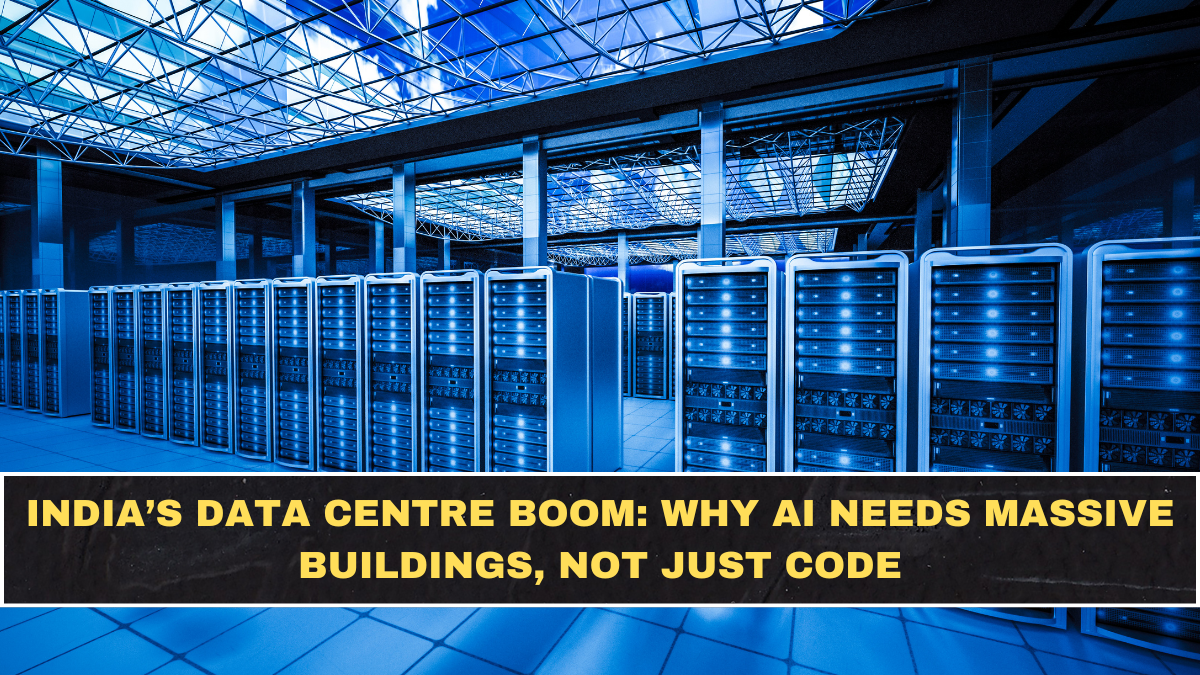
India’s data centre boom is accelerating because AI, cloud computing, streaming, UPI, e-commerce and data localisation are all demanding more computing power. This is the part most people miss: AI does not run in the air. Every chatbot, recommendation engine, payment system and enterprise automation tool needs servers, cooling, power and secure buildings behind it.
India’s data centre capacity has already grown sharply, with MeitY-linked reporting saying capacity rose from 375 MW in 2020 to more than 1,500 MW by 2025. Another recent report projected India’s capacity could surge nearly six-fold from 1.8 GW to about 10.5 GW by FY2031, driven by AI adoption and data localisation policies.
Why Does AI Need Physical Infrastructure?
AI may look like software, but it is brutally physical underneath. Training and running AI models require high-performance chips, dense server racks, storage systems, fast networks and cooling systems that can handle huge heat loads. That is why the AI race is also becoming a data centre race.
A report cited by The New Indian Express said India’s installed capacity may reach 1.7–2.0 GW by the end of 2026, backed by nearly $30 billion in investments, while Deloitte estimates capacity could grow to 8–10 GW by 2030. This means India is not only building digital apps; it is building the heavy infrastructure needed to keep those apps alive.
| Growth Driver | Why It Needs Data Centres? | Impact On India |
|---|---|---|
| AI adoption | Needs GPUs, servers and storage | Higher compute demand |
| Cloud migration | Companies shift from local servers | More hyperscale capacity |
| UPI and digital payments | Real-time processing at scale | Low-latency infrastructure |
| Data localisation | More data stored within India | Domestic capacity growth |
| OTT and gaming | Heavy streaming and user data | More edge data demand |
Why Are Big Companies Entering This Space?
Big companies are entering because India’s digital demand is too large to ignore. Uber is reportedly setting up its first India data centre in partnership with the Adani Group, showing how global platforms now want stronger local infrastructure for speed, reliability and data handling. This is not just about one company; it signals where the market is moving.
The brutal business logic is simple. If India keeps generating massive digital traffic, companies cannot depend only on overseas or limited regional infrastructure. They need local data centres to reduce latency, improve compliance, support AI workloads and serve users faster. Whoever controls reliable infrastructure can become a serious power player in India’s digital economy.
Which Cities Could Benefit Most?
India’s data centre growth is likely to concentrate around major digital and connectivity hubs such as Mumbai, Chennai, Hyderabad, Bengaluru, Noida and Pune. These cities have better power access, fibre connectivity, enterprise demand, cloud customers and submarine cable advantages. Mumbai and Chennai are especially important because international connectivity matters heavily for cloud and data traffic.
However, the next phase may not stay limited to metros. As 5G, AI apps and digital services spread deeper into India, demand for edge data centres closer to users may rise. That means tier-2 and tier-3 cities could also see smaller but important infrastructure growth over time.
What Are The Hidden Problems?
The boom sounds exciting, but pretending there are no risks would be stupid. Data centres consume huge amounts of electricity and water, especially when dense AI workloads require powerful cooling. If India scales without planning, the same infrastructure meant to power AI can create pressure on grids, land and local resources.
The New Indian Express highlighted rising power and water demand as a major concern in India’s data centre expansion. This is where sustainability becomes non-negotiable. India needs renewable energy, efficient cooling, water recycling and better grid planning, or the data centre boom could become an environmental and infrastructure headache.
Key risks India must manage:
- Heavy electricity demand from AI servers
- Water usage for cooling in stressed regions
- Land availability near major cities
- Cybersecurity and physical security risks
- Shortage of skilled data centre technicians
- Dependence on imported chips and hardware
Who Will Actually Benefit?
The biggest winners will be cloud providers, telecom firms, real estate developers, power companies, cooling-equipment makers and AI infrastructure players. Tech workers with skills in cloud, networking, cybersecurity, DevOps, data engineering and data centre operations may also see stronger demand as the sector expands.
But the benefit will not automatically reach everyone. If India builds only elite infrastructure for large corporations, smaller businesses may still struggle with affordable AI access. The real win will come when data centre growth supports startups, public services, regional businesses and affordable AI tools, not just hyperscale giants.
What Is The Conclusion?
India’s data centre boom proves that AI is not just about clever code or viral chatbots. It needs massive buildings, power, cooling, chips, fibre networks and skilled people. As AI and cloud adoption rise, data centres will become core infrastructure for India’s digital economy.
The opportunity is huge, but the weak spot is execution. India must build fast, but it must also build responsibly. If power, water, sustainability and skills are ignored, the boom will create bottlenecks. If handled well, data centres could become one of the strongest foundations of India’s AI future.
What Are The Biggest FAQs?
Why Are Data Centres Growing So Fast In India?
Data centres are growing fast because India’s digital economy is expanding through AI, cloud services, UPI, e-commerce, OTT platforms and data localisation. More digital activity means more servers, storage and processing capacity are needed inside the country.
How Much Could India’s Data Centre Capacity Grow?
Recent reports project India’s data centre capacity could grow from about 1.8 GW to nearly 10.5 GW by FY2031. Other estimates suggest installed capacity may reach 8–10 GW by 2030 if investment and demand continue strongly.
Why Does AI Need Data Centres?
AI needs data centres because models require powerful servers, GPUs, storage, networking and cooling systems. Without this infrastructure, AI tools cannot run reliably at large scale for businesses, governments or consumers.
What Is The Biggest Risk In India’s Data Centre Boom?
The biggest risk is infrastructure pressure, especially electricity and water demand. If India does not build efficient, renewable-powered and well-planned data centres, the AI infrastructure boom could create serious sustainability problems.