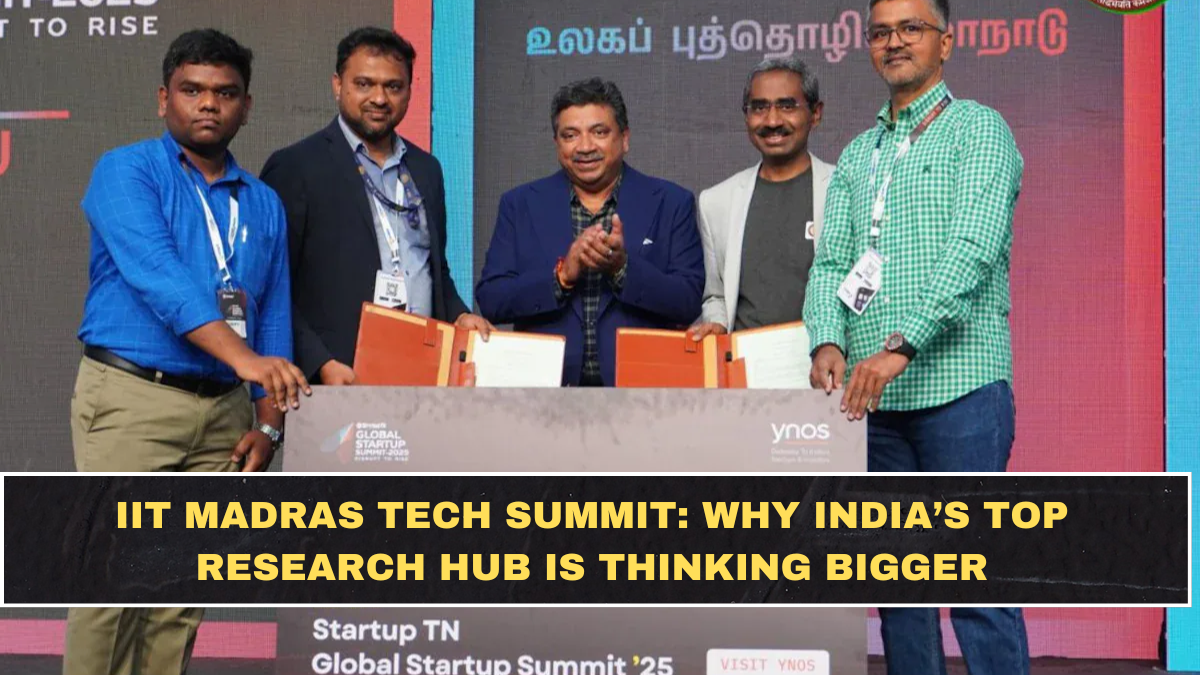
IIT Madras held its first-ever Technology Summit at Bharat Mandapam, New Delhi, on May 5, 2026, under the theme “From IITM. For Bharat. Building Together.” The summit was inaugurated by Union Education Minister Dharmendra Pradhan and focused on building stronger collaboration between industry, academia and government for India’s development journey. This was not a normal college event; it was a serious attempt to position IIT Madras as a national technology engine.
The timing matters because India is trying to turn research into actual products, startups and public-use technologies. IIT Madras has already built a strong reputation in deep-tech, patents, incubation and industry-linked research, but this summit pushed a bigger message: research should not stay trapped inside labs. It must reach markets, ministries, companies and ordinary citizens faster.

What Was The Summit Really About?
The summit brought together government leaders, industry executives, researchers, startups and academic teams to discuss technology-led pathways for Viksit Bharat. According to IIT Madras, the event showcased innovations from 15 Centres of Excellence, interdisciplinary schools and major research initiatives. Director V. Kamakoti described it as a call to action for deeper collaboration between industry, corporates and academia.
| Summit Highlight | Why It Matters |
|---|---|
| First-ever IIT Madras Tech Summit in Delhi | Signals national-level ambition |
| Theme: “From IITM. For Bharat. Building Together.” | Focuses on real India impact |
| 15 Centres of Excellence showcased | Shows depth of research ecosystem |
| Government-industry-academia platform | Pushes collaboration beyond speeches |
| Book released on 25 years of impact | Builds long-term institutional credibility |
The important point is that IIT Madras is not only trying to show what it has already built. It is trying to attract partners who can fund, scale and deploy these technologies. That is the missing bridge in India’s innovation story: strong research exists, but commercialisation and adoption are still too slow.
Why Is Industry Partnership The Real Test?
India does not lack talent, but it often struggles to convert research into large-scale products. Dharmendra Pradhan said India’s innovation ecosystem is at a crucial turning point and stressed that private-sector investment in research and innovation must rise. That statement matters because government funding alone cannot build a global deep-tech economy.
IIT Madras had earlier said its industry-funded research reached ₹966 crore in 2025-26 and that more than 400 startups had been created so far. These numbers are strong, but the real challenge is scale. If industry only attends summits but avoids long-term funding, pilot projects and procurement, the entire innovation pipeline becomes more decorative than useful.
Why Are Startups Central To This Story?
The IIT Madras startup ecosystem is becoming one of the strongest parts of its national influence. Times of India reported that the IIT Madras Incubation Cell has a portfolio of 567 startups with a combined valuation of ₹74,100 crore. It also reported that 112 startups were incubated in FY2025-26, while the ecosystem is now aiming to build a stronger IPO pipeline.
Key startup signals from IIT Madras:
- 567 startups in the incubation portfolio
- ₹74,100 crore combined portfolio valuation
- 112 startups incubated in FY2025-26
- Strong activity in space-tech and deep-tech
- Focus shifting toward IPOs and unicorn creation
This is where IIT Madras becomes more than an education brand. If its startups keep moving toward commercial scale, the institute can influence jobs, manufacturing, defence, health-tech, climate-tech, agriculture and semiconductors. But the hard truth is that startup numbers alone are not enough. India needs survival, revenue and real customers, not only pitch-deck success.
Can This Help India’s Deep-Tech Ambition?
Yes, but only if the summit leads to actual partnerships. Deep-tech startups need patient capital, testing facilities, regulatory support and early customers. Times of India reported that IIT Madras Incubation Cell is seeing emerging activity in agriculture, climate-tech, quantum computing and semiconductors, while global investors and corporate venture arms are showing more interest.
The uncomfortable reality is that India talks a lot about innovation but often makes deep-tech founders fight slow procurement, funding gaps and difficult compliance processes. If IIT Madras can use this summit to connect research teams with serious industry money and government deployment channels, it could become a model for other institutes. If not, this will become another polished event with limited ground impact.
Conclusion: Why Does This Summit Matter?
IIT Madras Technology Summit 2026 matters because it shows India’s top research institutions are trying to move from academic excellence to national execution. The Delhi location, government presence, industry focus and Bharat-first theme all signal that IIT Madras wants its research to shape real development, not just rankings and publications.
The honest verdict is simple: the summit is promising, but promises are cheap. IIT Madras has the talent, startup base and research credibility. Now it must prove that its ecosystem can produce scalable technologies, serious jobs, export-ready products and solutions for Indian problems. That is the difference between a great institute and a true national innovation machine.
FAQs
What Is The IIT Madras Technology Summit 2026?
The IIT Madras Technology Summit 2026 was the institute’s first-ever technology summit in New Delhi. It was held at Bharat Mandapam on May 5, 2026, with the theme “From IITM. For Bharat. Building Together.”
Who Inaugurated The IIT Madras Tech Summit?
Union Education Minister Dharmendra Pradhan inaugurated the summit. The event brought together leaders from government, industry and academia to discuss technology-led development for India.
What Did IIT Madras Showcase At The Summit?
IIT Madras showcased research and innovations from 15 Centres of Excellence, interdisciplinary schools and major research initiatives. The focus was on translating academic research into real-world applications.
Why Is The Summit Important For Indian Startups?
The summit is important because IIT Madras already has a large startup ecosystem, including 567 incubated startups with a combined valuation of ₹74,100 crore. Stronger industry and government partnerships can help these startups scale beyond labs and pilots.