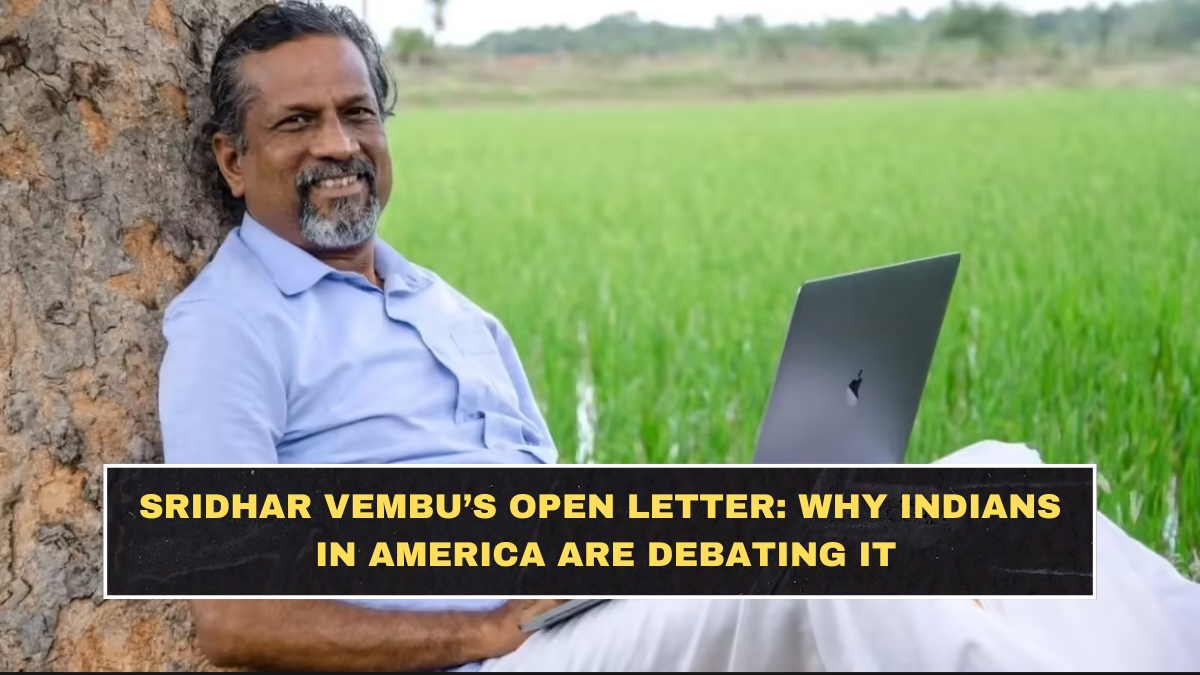
Sridhar Vembu’s open letter is trending because the Zoho founder urged Indians living in the United States to consider returning to India and helping build the country’s technological future. In his post on X, Vembu addressed “brothers and sisters from Bharat” and appealed to successful Indian-origin professionals abroad to bring their experience back home.
The message has triggered debate because it touches several emotional topics at once: immigration, identity, national duty, racism, technology leadership, brain drain, and India’s global respect. Vembu also linked his appeal to rising anti-immigrant sentiment and the feeling that Indians in America are increasingly caught between political extremes.
This is why the post is not being treated as a normal patriotic statement. It comes from a serious Indian tech entrepreneur who himself spent decades in the United States before returning to India. That personal history gives the message weight, but it also makes the argument more complicated than a simple “come back home” slogan.
What Did Sridhar Vembu Actually Say?
Vembu recalled that many Indians went to America with little money but strong education and cultural roots. He acknowledged that America gave Indian professionals major opportunities and said gratitude remains important. At the same time, he warned that many Americans now believe Indians take away jobs or earned success unfairly.
He also argued that Indians in the US should not assume the next election will fix deeper social tensions. Reports quoted him describing the political environment as a battle between the “hard right” and the “woke left,” with Indians positioned as bystanders in that conflict.
The strongest part of his appeal was about India’s own future. Vembu said India needs technology leadership, not just talent working abroad. His argument is that global respect for Indians will depend on India becoming economically, technologically, and strategically stronger.
Why Are People Supporting His Message?
Many people are supporting Vembu’s message because it speaks to a long-running concern: India has produced world-class engineers, founders, researchers, doctors, and executives, but a large share of that talent has built careers abroad. Supporters believe reverse migration can help India build stronger companies, research ecosystems, and product-led technology platforms.
There is also an emotional layer. For many Indians, Vembu’s message feels like a call for successful NRIs to contribute to the country that educated and shaped them. His phrase about India needing their talent has resonated with people who believe national development requires experienced professionals to return, mentor, invest, and build institutions.
| Debate Point | Supporters’ View | Critics’ Concern |
|---|---|---|
| Returning to India | Helps nation-building and tech leadership | Not everyone has equal opportunity back home |
| US immigration pressure | Indians face growing hostility and uncertainty | The US still offers strong career pathways |
| Brain drain | Experienced talent should return and mentor | Global careers can also help India indirectly |
| National respect | India must build power at home | Respect also needs governance and quality of life |
| Emotional appeal | Inspiring and patriotic | May oversimplify personal realities |
Why Are Some Indians Criticising The Appeal?
Some Indians are criticising the appeal because returning home is not a simple emotional decision. People in America may have children in school, mortgages, long-term careers, immigration applications, ageing parents, healthcare needs, and financial commitments. Asking everyone to return without addressing practical realities can sound inspirational but incomplete.
Critics also argue that India must first create enough high-quality research jobs, fair workplaces, strong public infrastructure, predictable governance, and global-level salaries before expecting large-scale return migration. That criticism is valid. Talent does not move only because of sentiment; it moves toward opportunity, stability, and respect.
This is the blind spot in overly patriotic arguments. You cannot shame people into returning while ignoring why they left or why they stayed abroad. If India wants top talent back, it must offer more than emotion. It must offer serious work, institutional quality, trust, and a future where their children also see opportunity.
What Does This Debate Reveal About Brain Drain?
The debate reveals that brain drain is no longer a one-way story. Earlier, Indian talent leaving for the US was often seen as permanent loss. Now, with India’s startup ecosystem, digital infrastructure, SaaS companies, and manufacturing ambitions growing, reverse migration has become a real possibility for some professionals.
Vembu’s own career adds credibility here because Zoho is one of India’s major software companies, and he has publicly promoted building technology capability from India, including outside traditional metro hubs. Reports also describe him as an advocate of rural development and technological self-reliance.
Still, brain drain cannot be solved by speeches alone. India needs stronger universities, deeper research funding, better hardware and semiconductor ecosystems, fairer hiring systems, and more product companies that can compete globally. Without those, only a small number of emotionally motivated professionals will return.
Is Returning To India The Only Way To Contribute?
No, returning to India is not the only way to contribute. Indians abroad can contribute through investment, mentoring, research partnerships, startup funding, university collaborations, policy advice, open-source projects, and global market access for Indian companies. Physical return is powerful, but it is not the only useful model.
This is where the debate needs maturity. Some people can return and build in India. Others can stay abroad and still help India through capital, knowledge, networks, and market connections. Treating one path as patriotic and the other as selfish is lazy thinking.
The better question is not “Should every Indian come back?” The better question is “How can Indian talent, wherever it lives, help build India’s capabilities?” That gives the debate a more practical direction and avoids turning personal life choices into moral fights.
Conclusion?
Sridhar Vembu’s open letter has gone viral because it combines patriotism, concern over US immigration sentiment, and a serious argument about India’s need for technology leadership. His message is powerful because it comes from someone who has lived both sides of the story: success in America and return to India.
But the debate should not become emotional blackmail. Returning to India can be meaningful, but it must also make practical sense. If India wants its global talent back, it must build stronger institutions, better opportunities, and world-class ecosystems. Sentiment may start the conversation, but execution will decide whether people actually return.
FAQs
Why Did Sridhar Vembu Write An Open Letter To Indians In America?
Sridhar Vembu wrote the open letter to urge Indian-origin professionals in America to consider returning to India and using their experience to build the country’s technological strength and long-term global standing.
What Was The Main Message Of Sridhar Vembu’s Letter?
His main message was that India needs the talent of successful Indians abroad. He argued that global respect for Indians will depend on India becoming stronger in technology, economy, and national capability.
Why Are People Debating His Appeal?
People are debating it because returning to India is emotionally appealing but practically difficult. Supporters see it as a patriotic call, while critics point to jobs, salaries, infrastructure, children’s education, immigration status, and family commitments.
Can NRIs Help India Without Returning Permanently?
Yes, NRIs can help through investment, mentoring, research partnerships, startup support, market access, and knowledge sharing. Returning to India is one option, but it is not the only way to contribute to India’s growth.