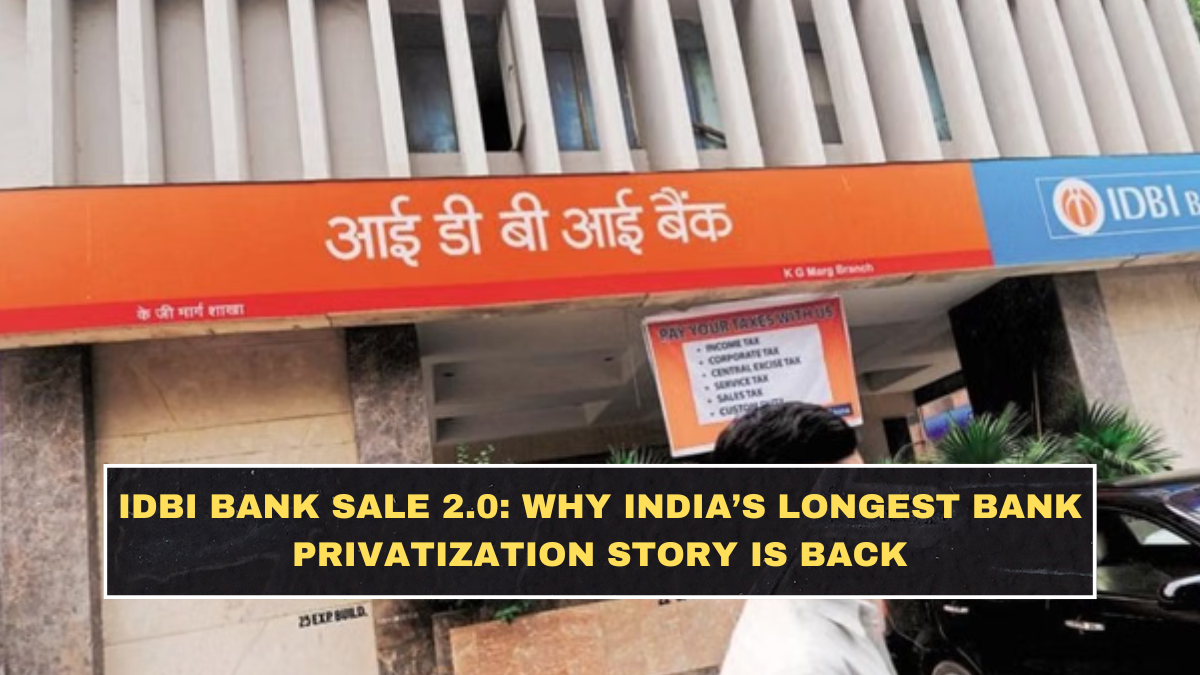
The IDBI Bank sale is back in focus because the government’s top disinvestment officials are reviewing the next phase of the bank’s strategic sale. Moneycontrol reported that the Core Group of Secretaries on Disinvestment was scheduled to meet on April 27, 2026, to review the IDBI Bank strategic sale after a fresh valuation exercise was started. The review comes even after months of delays and uncertainty around bidder interest.
This matters because IDBI Bank is not a normal small stake sale. It is one of India’s longest-running bank privatization attempts and is being watched as a test case for whether the government can actually privatize a bank with management control transfer. If this sale works, it can send a signal that banking-sector reforms are still alive.
But the process has also exposed a hard truth. Selling a bank is much harder than selling shares in a normal company. A bank has depositors, regulators, capital requirements, branch networks, pension liabilities, bad-loan history, and public trust issues. That is why the IDBI Bank story keeps coming back but never seems to finish cleanly.
What Is The Government Trying To Sell?
The government and Life Insurance Corporation of India together control most of IDBI Bank. Economic Times reported that the government owns 45.48% of IDBI Bank, while LIC holds 49.24%, leaving about 5% with the public. The planned strategic sale involved selling a combined 60.72% stake and transferring management control to a private buyer.
That management control point is important. This is not just about reducing government shareholding on paper. The sale is meant to bring in a new owner who can run the bank, improve efficiency, strengthen technology, and possibly grow the business more aggressively than a state-linked structure allows.
| Stakeholder | Current Role | Why It Matters |
|---|---|---|
| Government of India | Holds 45.48% stake | Wants to reduce ownership through disinvestment |
| LIC | Holds 49.24% stake | Became key owner after rescuing the bank |
| Public shareholders | Hold around 5% | Low public float affects market liquidity |
| Strategic buyer | Expected to buy majority stake | Would get management control |
| RBI | Regulator | Must clear buyer through fit-and-proper checks |
Why Has The IDBI Bank Privatization Taken So Long?
The IDBI Bank privatization has taken so long because it involves valuation, regulatory approval, bidder scrutiny, employee concerns, liabilities, and political sensitivity. The government invited bids years ago, but the process has moved slowly through due diligence, bidder clearance, financial bids, and valuation questions.
Reuters reported in March 2026 that IDBI Bank shares fell sharply after reports suggested the government may scrap the majority stake sale because bids were below its minimum price expectations. The Reuters report said the proposed divestment involved a combined 60.72% stake held by the government and LIC, and that IDBI Bank clarified it had not received formal communication about the process being scrapped.
The problem is not only delay. The problem is trust between buyer expectations and government expectations. Investors want a price that reflects risks, liabilities, regulation, and future capital needs. The government wants a price that looks fair to taxpayers and does not appear like a distress sale. That gap is exactly where privatization processes get stuck.
Why Did The Earlier Bids Create A Problem?
The earlier bids reportedly created a problem because they were lower than the reserve price expected by the government. Economic Times reported that the government may ask two potential buyers for revised financial bids because their original offers were below the reserve price fixed for the strategic sale. It also quoted a senior official saying the sale was in the technical evaluation stage.
This is where the government faces an uncomfortable choice. If it sells at a lower price, it may be accused of undervaluing a public asset. If it refuses to sell unless the price is high, the process may drag for years and investors may walk away. Neither option is painless.
The blunt reality is that the market does not care about government pride. Buyers will price the bank based on risk, future earnings, regulatory comfort, and capital needs. If the government expects a premium without solving investor concerns, the sale will keep getting stuck.
Why Is RBI Approval So Important?
RBI approval is important because a bank is not like an ordinary company. Whoever buys control of IDBI Bank must be financially sound, transparent, and fit to own a regulated lender. The Reserve Bank of India must be comfortable that the buyer will not create risk for depositors or the banking system.
This fit-and-proper process is one reason bank privatization is slower than regular disinvestment. Potential buyers are checked for ownership structure, financial strength, regulatory history, funding source, and governance ability. That is necessary because banking failures can damage ordinary depositors and financial stability.
The government may want to move fast, but RBI cannot treat this like a simple auction. A high bidder is not automatically the right owner of a bank. If the buyer’s structure or funding is unclear, the regulator has to slow things down. That is not bureaucracy; that is basic banking safety.
Why Does This Sale Matter For India’s Privatization Policy?
The IDBI Bank sale matters because it has become a symbol of India’s wider privatization challenge. The government has talked about strategic disinvestment for years, but execution has often been slower than announcements. If IDBI Bank is finally sold successfully, it can build confidence in future bank and public-sector sales.
DIPAM’s own website has continued to reference updates on the IDBI Bank disinvestment process, including completion of expression of interest activity, due diligence, data room work, and consultations. It also mentioned that the winner was expected to be announced by FY26-end in earlier official communication.
But if the sale fails again, it sends the opposite signal. Investors may conclude that India wants privatization headlines but struggles to close complex deals. That would hurt credibility, especially when strategic sales need patient private capital and regulatory confidence.
What Could Happen Next?
The government has a few options. It can ask bidders to revise offers, restart the process from scratch, reconsider the reserve price, use market routes to reduce shareholding, or delay the sale until market conditions improve. None of these paths is perfect.
Moneycontrol reported that the April 27 review was the first high-level review since fresh valuation was initiated, suggesting the government is not abandoning the process yet. Economic Times also reported that revised bids may be sought from two suitors after original bid amounts fell short.
For investors, the key question is whether the government wants completion or maximum valuation. It may want both, but real transactions often require compromise. For taxpayers and depositors, the key question is whether the new owner will strengthen the bank without creating systemic or governance risk.
Conclusion?
The IDBI Bank sale is back because the government is trying to revive one of India’s most watched privatization deals. The bank has major public ownership, a planned management-control transfer, and a sale structure that could become a model for future banking reforms.
But this story also shows why privatization is difficult. Valuation gaps, bidder caution, RBI scrutiny, liabilities, public trust, and political optics all matter. If the government wants this sale to work, it needs a realistic price, a credible buyer, and regulatory comfort. Without that, IDBI Bank will remain stuck as India’s longest-running bank sale story.
FAQs
What Is The IDBI Bank Sale?
The IDBI Bank sale is the government and LIC’s plan to sell a combined majority stake in IDBI Bank and transfer management control to a strategic buyer. The proposed sale involved a combined 60.72% stake.
Who Owns IDBI Bank Now?
The Government of India owns 45.48% of IDBI Bank, while LIC owns 49.24%. Around 5% is held by public shareholders, according to recent reports.
Why Has The IDBI Bank Privatization Been Delayed?
The sale has been delayed because of valuation gaps, regulatory approvals, bidder scrutiny, due diligence, liability concerns, and the complexity of transferring control of a regulated bank.
What Happens If The IDBI Bank Sale Fails Again?
If the sale fails again, the government may need to restart the bidding process, seek revised bids, reduce stake through market routes, or wait for better market conditions. It may also weaken confidence in future strategic disinvestment plans.