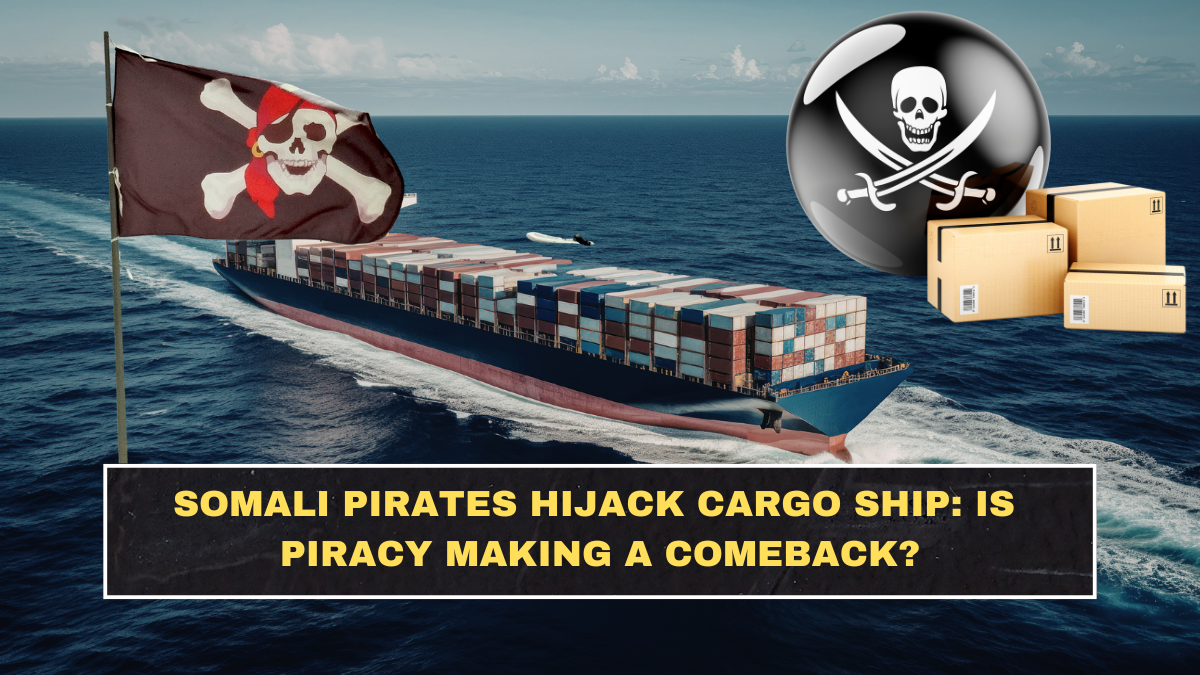
According to AP, a Puntland maritime official said nine armed individuals boarded the cement vessel off the coast of Garacad. Reuters reported that British maritime security groups Vanguard and Ambrey said suspected pirates had boarded a St. Kitts and Nevis-flagged general cargo vessel and were steering it toward the Somali coastline. UK Maritime Trade Operations also reported unauthorised persons taking control of a vessel near Garacad.
This is important because piracy is not only about boarding a ship. The danger rises when attackers take control of navigation, move the vessel toward shore, and possibly use the crew, cargo, or ship itself for leverage. NDTV, citing maritime-security information, reported that the vessel was named Sward and had a 15-person crew, including two Indian nationals and 13 Syrians. Crew safety will now be the biggest immediate concern.

| Key Detail | What Is Known So Far |
|---|---|
| Location | Near Garacad, Puntland, Somalia |
| Vessel type | General cargo ship carrying cement |
| Flag | St. Kitts and Nevis |
| Reported route | Egypt to Mombasa, Kenya |
| Attackers | Around nine armed individuals, according to Puntland official |
| Main concern | Crew safety and possible piracy resurgence |
Why Is Puntland A Piracy Hotspot Again?
Puntland has long been linked to Somali piracy because of its coastline, weak local enforcement capacity, clan-linked networks, fishing disputes, and access to maritime routes. Piracy off Somalia declined sharply over the past decade due to international naval patrols, armed guards, better shipping practices, and stronger regional monitoring. But decline does not mean elimination.
The uncomfortable reality is that piracy returns when the economics make sense again. If ships are vulnerable, security patrols are stretched, local armed groups have opportunity, and global attention is focused elsewhere, pirates test the waters. The current Red Sea, Gulf of Aden, and wider Middle East shipping disruptions may be creating exactly that opening.
Is Somali Piracy Really Making A Comeback?
It may be starting to return, but the scale is not yet comparable to the peak years. Somali piracy caused major disruption from around 2008 to 2018, with ships hijacked for ransom and crews held for long periods. Since then, serious attacks became much rarer. However, activity began picking up again from late 2023, especially after regional shipping security became more complicated.
The MV Ruen case in late 2023 was a warning sign. The vessel was hijacked by Somali pirates and later recaptured by the Indian Navy in March 2024, with the crew rescued. The Guardian described that hijacking as the first successful pirate attack on a cargo vessel since 2017. That case showed that Somali pirate networks were not dead; they were dormant, opportunistic, and capable of returning when conditions allowed.
Why Does This Matter For Global Shipping?
This matters because global shipping is already under pressure from war, chokepoint disruption, insurance costs, and rerouting. The Red Sea has faced serious security problems, the Strait of Hormuz crisis has shaken energy routes, and now piracy concerns near Somalia add another layer of risk. Shipping companies do not evaluate threats in isolation. They look at the whole route map.
If piracy risks rise near Somalia, vessels may need extra security, higher insurance cover, longer routes, naval coordination, or higher freight rates. Those costs can move through the supply chain. A hijacked cargo ship near Puntland may sound far away, but if it increases shipping risk across the Horn of Africa, the cost can eventually reach importers, retailers, and consumers.
Why Are Pirates Targeting Cargo And Fuel Ships?
Cargo and fuel ships are attractive because they can be used for ransom, resale leverage, local bargaining, or operational advantage. A cement cargo may not sound as valuable as oil, but the ship and crew themselves can be valuable in ransom negotiations. Fuel tankers are even more sensitive because fuel is immediately useful and often easier to monetise locally.
AP reported that the earlier tanker hijacking involved a vessel carrying a large fuel shipment and travelling toward Mogadishu. No ransom demand had been reported at the time, but the pattern is worrying: pirates may be testing different vessel types and routes to see where security is weakest.
What Is The Risk For Indian And International Crew Members?
The greatest immediate risk is to the crew. Piracy cases can involve hostage-taking, forced movement, physical threats, food and water shortages, and long negotiation periods. Even when crews are eventually rescued, the psychological trauma can be severe. The reported presence of Indian and Syrian crew members makes this a direct international concern, not only a Somali issue.
India has played a visible anti-piracy role in the region before. In March 2024, the Indian Navy recaptured the MV Ruen and rescued all 17 crew members after a standoff. That operation showed how naval intervention can work, but it also showed how dangerous these cases become once pirates control the ship and move it toward Somali waters.
What Can Stop Somali Piracy From Returning?
The solution is not one thing. Naval patrols help, but they are expensive and cannot cover every vessel. Shipping companies need stronger route planning, onboard security protocols, safe-room procedures, tracking discipline, and quick reporting. Regional authorities also need better coastal enforcement, intelligence sharing, and local disruption of pirate networks before hijackings become normal again.
There is also a deeper issue: piracy feeds on weak governance and economic desperation. If coastal communities see no legal income and armed groups can profit from hijackings, piracy becomes attractive again. Maritime security can suppress piracy, but long-term prevention needs coastal policing, legal fishing protection, jobs, and functioning local authority.
Conclusion
The hijacking of a cement-carrying cargo ship off Puntland is a serious warning sign. It came only days after a fuel tanker was seized, and both incidents suggest Somali piracy may be trying to re-enter a shipping environment already weakened by war and chokepoint disruption. This is not yet a return to the worst years of Somali piracy, but ignoring it would be foolish.
The blunt truth is that piracy never disappeared because the root conditions never fully disappeared. It was suppressed by naval pressure and better ship security. If those protections weaken or global attention shifts elsewhere, pirates will test the system again. For shipping companies, governments, and crew families, the Puntland hijacking is not just one ship. It is a signal that the Horn of Africa may be becoming dangerous again.
FAQs
What ship was hijacked off Somalia?
A St. Kitts and Nevis-flagged cargo vessel carrying cement was reportedly hijacked near Garacad in Somalia’s Puntland region. Some maritime reports identified the vessel as Sward, with a crew of 15 people.
Were Somali pirates involved in the hijacking?
Authorities and maritime-security groups described the attackers as suspected pirates. Puntland officials said armed men boarded and took control of the vessel, while UK-linked maritime monitors reported unauthorised persons steering the ship toward Somalia.
Is Somali piracy returning?
There are signs of renewed piracy risk, especially after two hijacking incidents near Puntland in less than a week. However, the current scale is still far below the peak Somali piracy years from 2008 to 2018.
Why does this matter for global shipping?
It matters because ships near Somalia may face higher security costs, insurance costs, route risks, and crew-safety concerns. If piracy grows while other shipping routes are already disrupted, global trade costs can rise further.