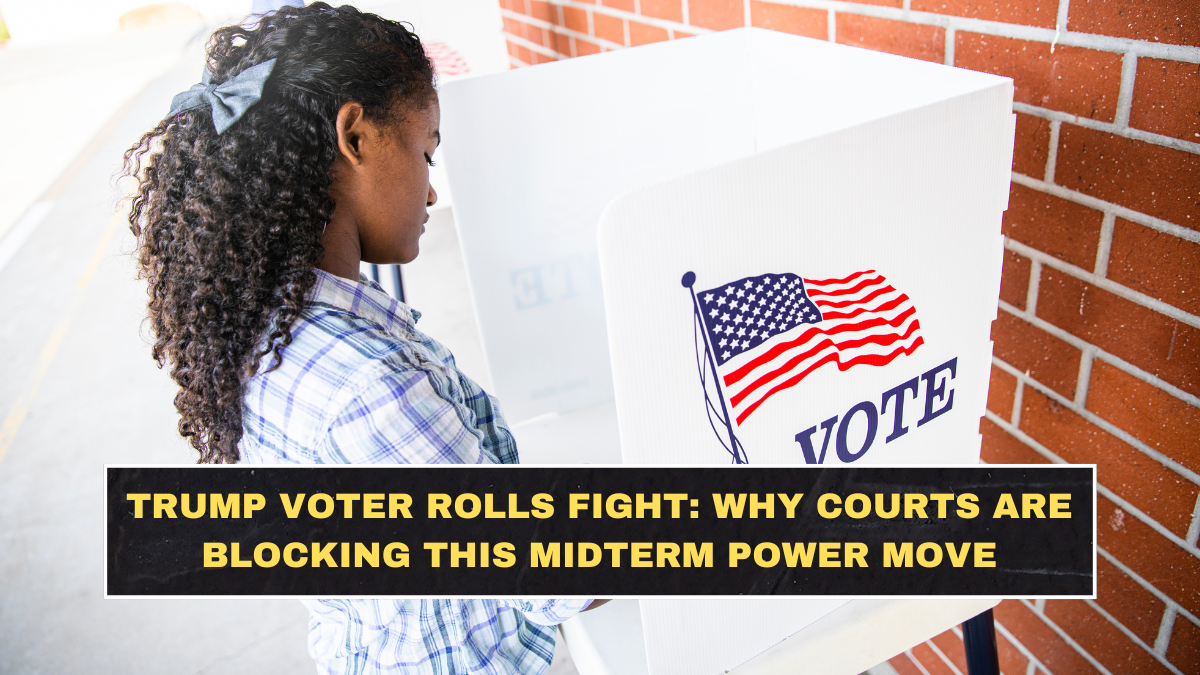
Trump’s voter rolls fight is becoming a major midterm issue because the administration is trying to obtain detailed voter registration data from states before the 2026 elections. Reuters reported that the Trump administration has faced a wave of court defeats in its push for access to state voter rolls, with opponents arguing the effort could unlawfully expand federal control over elections.
This matters because US elections are largely run by states, not the federal government. When Washington asks for sensitive voter data from dozens of states, it immediately raises questions about privacy, election control, voter purges and political motive. The administration says it wants to check compliance with election laws. Critics say the move looks like a dangerous attempt to build federal power over voter lists before the midterms.
What Voter Data Does The Trump Administration Want?
The Department of Justice has sought detailed voter registration information from states, including personal identifiers that can include addresses, dates of birth, driver’s license numbers and partial Social Security numbers. The Guardian reported that the Arizona case involved demands for sensitive voter information that state officials argued was not authorized under federal law.
That is why the fight is so sensitive. A voter roll is not just a list of names. It can contain private data that could be misused, exposed or matched against flawed databases. If the federal government uses inaccurate citizenship or identity checks, eligible voters could be wrongly flagged. That is the fear driving many of the lawsuits.
| Issue | Why It Matters? |
|---|---|
| State voter rolls | Elections are traditionally administered by states |
| Personal voter data | Includes sensitive identifiers and privacy risks |
| Federal access | Could expand Washington’s role in election administration |
| Voter purges | Critics fear eligible voters could be wrongly removed |
| Midterm timing | The fight comes before a high-stakes national election |
| Court rulings | Several judges have rejected DOJ demands |
What Did The Arizona Court Decide?
A federal judge in Phoenix dismissed the Justice Department’s lawsuit seeking access to Arizona’s detailed voter registration records. AP reported that Judge Susan Brnovich ruled the requested data was not subject to federal disclosure under current law and dismissed the case with prejudice, meaning the lawsuit cannot be refiled.
Arizona Secretary of State Adrian Fontes called the ruling a victory for voter privacy. That framing matters because the court did not merely delay the request. It rejected the legal basis for the demand. For states resisting federal access, the Arizona ruling gives them another strong example to use in their own fights.
How Many States Are Involved In This Fight?
This is not a one-state dispute. AP reported that the DOJ has pursued similar actions in more than 30 states and Washington, D.C., while 13 states have agreed to provide detailed voter records. Courts in several states, including California, Michigan and Oregon, have also ruled against the DOJ in similar cases.
That scale is exactly why the story is politically explosive. If the DOJ were only investigating one state after a clear problem, the fight would look narrower. But when the administration seeks voter data across much of the country, critics see a national strategy to centralize election information before the midterms.
Why Are Voting Rights Groups Suing?
Voting rights groups are suing because they fear the data push could lead to illegal or inaccurate voter purges. Reuters reported that groups including the ACLU, Citizens for Responsibility and Ethics in Washington, and Protect Democracy sued the DOJ over its demand for state voter rolls, accusing the administration of laying groundwork for improper removals before the midterms.
Their concern is not theoretical. If voter data is matched against imperfect federal systems, people with name changes, data-entry errors, naturalization records, common names or outdated documents could be wrongly flagged. Once flagged, voters may have to fight to prove eligibility. That burden can suppress turnout even if the voter is legally allowed to vote.
What Does The Trump Administration Say?
The administration says it needs the information to enforce federal election laws and ensure voter rolls are accurate. The DOJ has cited the National Voter Registration Act and argued that unredacted data is needed to examine compliance. Supporters of the effort say clean voter rolls protect election integrity and prevent fraud.
That argument has political power because many voters support accurate registration lists. But the weak point is legal authority and method. Courts are not rejecting the idea that voter rolls should be accurate. They are questioning whether the federal government has the right to demand sensitive state data in this way. That distinction matters.
Why Are Courts Blocking The Requests?
Courts are blocking the requests because judges have found that the DOJ has not shown clear legal authority to access the detailed data it wants. In Arizona, the court ruled the information was not subject to federal disclosure under current law. Similar rulings in other states suggest judges are skeptical of the administration’s interpretation.
This is where Trump’s strategy is hitting a wall. Election integrity is a strong political slogan, but courts demand statutory authority. If the law does not clearly allow the federal government to collect sensitive state voter data, judges can stop the effort no matter how loudly the administration frames it as security.
Why Does This Matter For The 2026 Midterms?
This matters for the 2026 midterms because voter rolls determine who can vote smoothly and who may face problems. If eligible voters are wrongly removed or flagged close to an election, they may miss deadlines, face confusion or avoid voting altogether. Even a small number of disputed registrations can matter in close races.
Reuters reported that the broader Trump election push includes efforts to increase federal involvement in elections that have historically been run locally. That wider context makes the voter-roll fight more important than a normal records dispute. It is part of a larger battle over who controls election machinery.
Is This Really About Fraud Or Control?
It may be about both, but the control issue is impossible to ignore. Clean voter rolls are legitimate. Every democracy needs accurate registration records. But demanding sensitive data from dozens of states before a major election, while using federal pressure and litigation, creates obvious risks of political misuse.
The blunt point is this: if the administration truly wants trust, it needs transparent legal authority, narrow requests, strong privacy safeguards and independent oversight. Without that, the voter-roll campaign looks less like routine election maintenance and more like a power grab dressed up as fraud prevention.
What Is The Bottom Line?
Trump’s voter rolls fight matters because it sits at the intersection of election integrity, voter privacy, federal power and midterm politics. Courts have repeatedly pushed back against the DOJ’s demand for sensitive state voter data, including a major dismissal in Arizona. That does not end the fight, but it weakens the administration’s legal position.
The hard truth is that voter-roll accuracy is important, but using vague fraud fears to justify broad federal access is dangerous. If the government gets sensitive voter data without clear limits, the risk is not only privacy loss. The bigger risk is that eligible voters could be wrongly targeted before an election.
FAQs
What Is Trump’s Voter Rolls Fight About?
It is about the Trump administration’s attempt to obtain detailed voter registration records from states before the 2026 midterms. The administration says it wants election-law compliance, while critics warn of privacy risks and possible voter purges.
Why Did A Federal Judge Block The Arizona Request?
A federal judge dismissed the DOJ’s Arizona lawsuit, ruling that the requested voter data was not subject to federal disclosure under current law. The case was dismissed with prejudice.
What Kind Of Voter Data Was Requested?
Reports say the data sought could include names, addresses, dates of birth, driver’s license numbers and partial Social Security numbers, raising serious privacy concerns.
How Many States Are Involved?
The DOJ has pursued similar actions in more than 30 states and Washington, D.C., while 13 states have reportedly agreed to provide detailed voter records.
Why Are Voting Rights Groups Worried?
They fear the data could be used with flawed verification systems, leading to eligible voters being wrongly flagged or removed from voter rolls before the midterm elections.