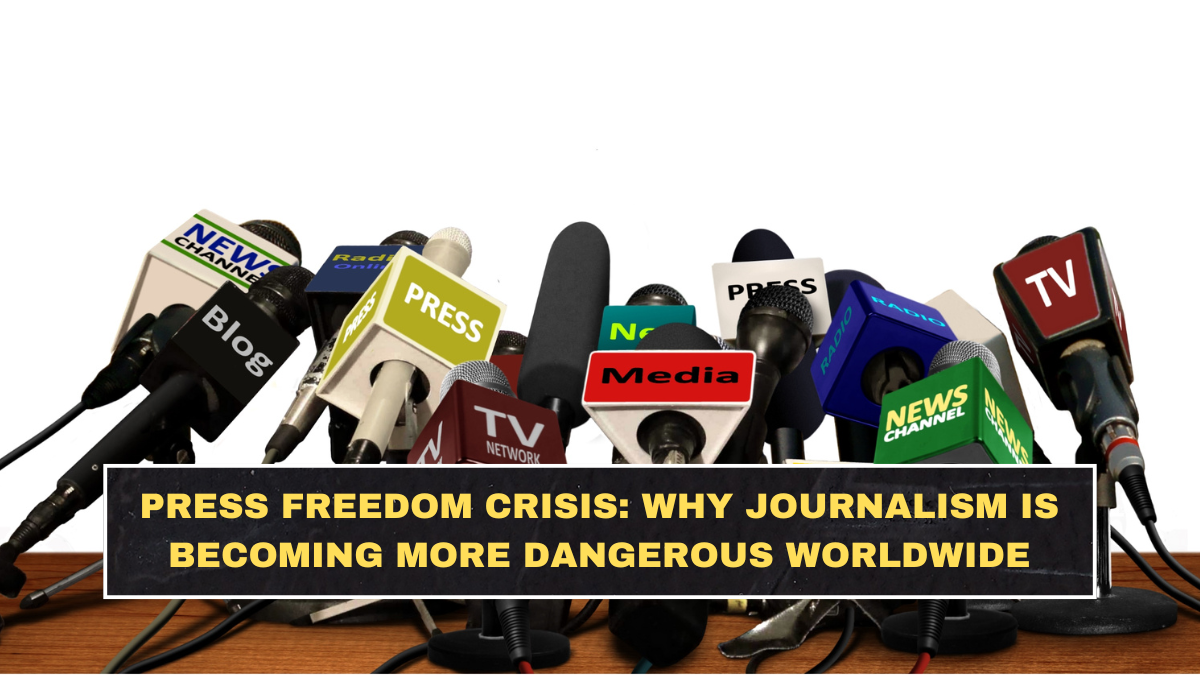
Press freedom is becoming a global crisis because journalists are being killed, jailed, sued, threatened and financially squeezed at alarming levels. The Committee to Protect Journalists reported that 129 journalists and media workers were killed worldwide in 2025, the highest annual number since CPJ began collecting data in 1992. That makes 2025 the deadliest year on record for the press.
This is not only happening in obvious war zones. Journalists are being targeted by governments, armed groups, criminal networks, security agencies and political actors across different regions. The pattern is clear: powerful people increasingly treat independent reporting as a threat, not as a public service. That is why the crisis matters far beyond the media industry. When journalism becomes dangerous, citizens lose access to reliable information.
What Do The Latest Numbers Show?
The latest numbers show that the press freedom situation is getting worse across several fronts. CPJ documented 129 journalists and media workers killed in 2025, while Reporters Without Borders said 67 media professionals were killed, 503 detained, 135 missing and 20 held hostage as of December 1, 2025. The difference in numbers comes from different counting methods, but both groups point to a grim reality.
Reporters Without Borders also warned in its 2025 World Press Freedom Index that more than half of the world’s population lives in countries where press freedom is in a “very serious” situation. That means billions of people are living in places where access to independent, reliable information is heavily restricted or under attack.
| Press Freedom Indicator | What The Latest Reports Show |
|---|---|
| Journalists killed in 2025 | CPJ recorded 129 journalists and media workers killed |
| Journalists detained | RSF reported 503 detained as of December 1, 2025 |
| Missing journalists | RSF reported 135 missing worldwide |
| Held hostage | RSF reported 20 journalists held hostage |
| Global press freedom | More than half the world’s population lives under “very serious” press freedom conditions |
| Biggest risk zones | War zones, authoritarian states and areas controlled by criminal networks |
Why Are So Many Journalists Being Killed?
Journalists are being killed because they are increasingly working in active war zones, authoritarian states and areas controlled by organised crime. CPJ said the 2025 death toll was driven heavily by conflict, especially Israel’s war-related attacks, with Israel responsible for a large share of journalist deaths. Al Jazeera, citing CPJ, reported that Israel killed at least 84 media workers and journalists in 2025.
This is one of the most uncomfortable parts of the crisis. Reporters are not only dying because they are accidentally near danger. In many cases, journalists are targeted because their work exposes what powerful actors want hidden. War reporting, corruption investigations, human rights coverage and criminal investigations are becoming life-threatening assignments.
Why Are Journalists Being Jailed?
Journalists are being jailed because many governments treat reporting as political opposition. CPJ’s prison reporting has repeatedly highlighted countries where authorities use vague charges such as terrorism, espionage, false information or collaboration with foreign media to silence journalists. OCCRP, citing CPJ, said countries including China, Iran, Turkey, Ethiopia, Egypt and Myanmar remain among the world’s worst jailers of journalists.
This tactic works because it creates fear beyond the person arrested. One journalist in prison can silence dozens more. Newsrooms become cautious, sources stop talking, and citizens receive less honest information. That is the point. Authoritarian governments do not always need to censor every article. Sometimes they only need to make an example of a few reporters.
Why Is China Often Mentioned In Press Freedom Reports?
China is often mentioned because it remains one of the most restrictive environments for journalists. Reporters Without Borders said China ranked 178th in its 2025 World Press Freedom Index and remained the world’s largest jailer of journalists. RSF also warned that China’s propaganda and media-control model influences other authoritarian governments across the Asia-Pacific region.
This matters because China’s influence is not limited to its own borders. Its model of surveillance, censorship, propaganda and pressure on foreign media has become attractive to governments that want economic growth without independent scrutiny. That is why press freedom groups watch China closely. It is not only a national issue. It is a template others may copy.
How Are Governments Using “False Information” Laws?
Governments are increasingly using “false information,” national security and cybercrime laws to punish journalism. The recent Kuwait case shows how broad these charges can become. A Kuwaiti-American journalist, Ahmed Shihab-Eldin, was detained for 52 days over accusations including spreading false information and harming national security before being acquitted. The charges were linked to online posts about the Iran war.
The danger is obvious. Misinformation laws can be necessary when they target genuine harmful deception, but they become dangerous when governments use them to punish verified reporting, criticism or sensitive coverage. If the state decides what is “false” without independent checks, journalism becomes hostage to political convenience.
Why Is Economic Pressure Also A Press Freedom Threat?
Economic pressure is a major threat because newsrooms need money to survive. Reporters Without Borders said economic fragility is a leading threat to press freedom in its 2025 index. When independent outlets lose revenue, face advertiser pressure, or are bought by politically connected owners, their ability to investigate power weakens.
This part gets ignored because it is less dramatic than arrests or killings. But financial pressure can be just as effective as censorship. A newsroom that cannot pay reporters cannot investigate corruption. A newspaper dependent on government advertising may avoid uncomfortable stories. A platform-dependent publisher may chase traffic instead of truth. Press freedom dies not only through bullets, but also through bankruptcy.
Why Should Ordinary People Care About Press Freedom?
Ordinary people should care because press freedom protects their right to know what is happening around them. Without independent journalism, corruption becomes easier, wars become less visible, police abuse becomes harder to prove, elections become easier to manipulate, and public money becomes easier to steal.
This is the basic point many people miss: press freedom is not a privilege for journalists. It is a protection for the public. A journalist asking hard questions is doing work that ordinary citizens usually do not have time, access or safety to do themselves. When reporters are silenced, the public becomes easier to lie to.
What Can Protect Journalists?
Journalists need legal protection, emergency funding, digital security, physical safety training and stronger accountability for attacks. Governments must investigate killings and stop using vague national security laws to jail reporters. Platforms and media owners also need to take responsibility by supporting credible journalism instead of rewarding outrage and propaganda.
International pressure matters too. When governments jail journalists, democratic states should not treat it as a minor human-rights side issue. Trade, aid, diplomacy and sanctions should reflect whether countries are attacking the free press. If there are no consequences, abusive governments will keep testing how far they can go.
What Is The Bottom Line?
The global press freedom crisis is not exaggerated. The data is ugly: CPJ recorded 129 journalists and media workers killed in 2025, while RSF reported hundreds detained and more than half the world’s population living under very serious press freedom conditions. The danger is spreading through war zones, authoritarian courts, economic pressure and online intimidation.
The blunt truth is that journalism is becoming more dangerous because too many powerful actors benefit when the public knows less. If people only defend press freedom when they like the journalist or agree with the outlet, they are missing the point. Free reporting is messy, imperfect and sometimes uncomfortable. But the alternative is worse: silence controlled by power.
FAQs
Why Is 2025 Called The Deadliest Year For Journalists?
CPJ reported that 129 journalists and media workers were killed worldwide in 2025, the highest annual total since it began collecting data in 1992.
How Many Journalists Were Detained Worldwide?
Reporters Without Borders said 503 journalists were detained worldwide as of December 1, 2025, while 135 were missing and 20 were held hostage.
Which Country Is The Largest Jailer Of Journalists?
Reporters Without Borders said China remains the world’s largest jailer of journalists and ranked 178th in the 2025 World Press Freedom Index.
Why Are Governments Using False Information Laws Against Journalists?
Some governments use false information or national security laws to punish reporting that embarrasses or challenges them. The Kuwait case involving Ahmed Shihab-Eldin shows how broad such charges can be used against journalists.
Why Does Press Freedom Matter To Ordinary People?
Press freedom matters because it helps expose corruption, war crimes, abuse of power, public-health failures and election manipulation. Without independent reporting, citizens are easier to mislead and control.